Articles
-
 When you do a lot of proposals, it’s easy to find yourself starting with the RFP. After all, you can’t really start proposal writing until you know what’s in the RFP. You can’t create the outline. You don’t know what the schedule is. You don’t know how many people you need to help. Etc. Unfortunately, I've seen the notion that the proposal starts with an RFP actually destroy entire companies. It tricks them into building their business around looking for RFPs they can respond to. Since thou
- 0 comments
- 7,262 views
-
 Most companies obsess over lead generation, when it's their win rate that ultimately determines their success. If your company lives or dies on its ability to win proposals, then everything depends on your win rate. Very few companies understand it, and even fewer build their companies around it. The ones that do are successful. The ones that don't aren't really in business, they are just gambling. Once you realize the importance of your win rate on your ROI, then the fun really starts. Tha
- 0 comments
- 7,717 views
-
 Carl Dickson of CapturePlanning.com and PropLIBRARY is a frequent public speaker. It's one of his favorite things. Because he runs a web-based empire he doesn't get out enough. He'd love to speak at your event, but can't do them all. You are welcome to ask. Let us know when, where, about the audience, and the topics you think will excite them. You can call us at 1-800-848-1563 or contact him through our site.
- 0 comments
- 2,758 views
-
 Proposal recipes work best when they reflect the specifics of the way your company does things and its circumstances. They can also help prevent your authors from reinventing the wheel. But you have to be careful when you make them specific that they remain applicable to all your bids. Luckily the question format facilitates this. You can include options that may or may not be applicable by how you phrase the questions. Instead of finding the balance between generic and specific, you can get as
- 0 comments
- 270 views
-
 The goal of a proposal recipe is to accelerate proposal writing and inspire your staff to write better approaches. Proposal recipes suggest topics to write about, instead of providing topics that are already written but in the wrong context. A proposal recipe avoids providing you with a narrative you can recycle. Instead, proposal recipes ask questions about everything that should go into the narrative. When you answer the questions, you not only create the narrative, but what you write is
- 0 comments
- 8,436 views
-
 Templates that recycle text or provide placeholders or form fields will reduce your win rate. The lost sales from a lower win rate far exceed the savings that using content templates or boilerplate might bring. Instead of recycling or automating proposal content, we focus on accelerating figuring out what your strategies should be and how you should position what you will write, and providing inspiration for what to write about. We'd rather make it easier to write a win rate lifting great propos
- 0 comments
- 31,318 views
-
 Use this cheat sheet to help craft better instructions for your proposal writers and provide guidance before they write their proposal sections, instead of trying to fix your proposals after they?ve been written.?
- 0 comments
- 1,360 views
-
 Some companies prepare their proposals like they are trying to ensure people are miserable. Some of them even take it as a point of pride that everyone hates working on proposals. If you make proposals easier, there will be less glory at the finish line. So maybe we’ve got it all wrong and need to avoid all that process-stuff. Instead let’s embrace making sure that everyone has a bad proposal experience. Here’s how: Hand them an outline and tell them to start writing. This makes it alm
- 0 comments
- 2,502 views
-
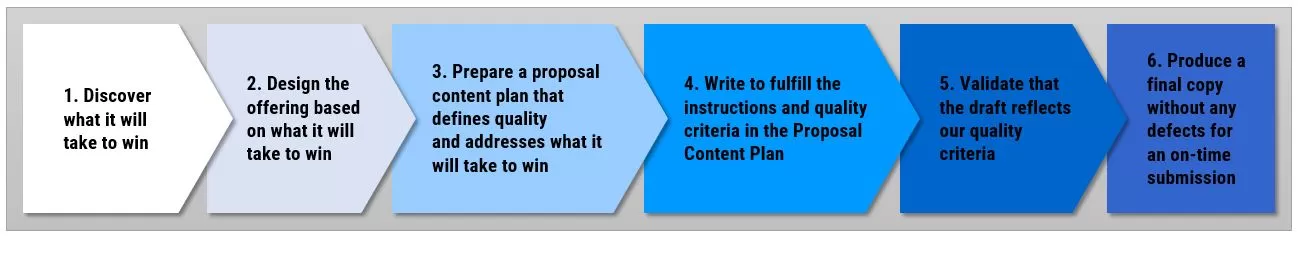 In the same way that the MustWin Performance Support Tool (MWPST) helps you plan, collaborate, validate, inspire, and accelerate the Proposal Content Plan, it can also be used to help implement a goal-driven process by: The MustWin Performance Support Tool shifts the focus from proposal data management and assembly, to creating proposals with meaning. Instructing proposal contributors regarding what is required to achieve each goal Facilitating their ability to ask questions and
- 0 comments
- 2,403 views
-
 Balancing the time to plan with the time to write against a deadline is more of an art than a science. The more you can do to accelerate the planning, the more time there is for writing. But don't forget that you have to think things through. If you rush through content planning without thinking things through, which is what an approach based on recycling proposals leads to, you can do more harm than good. Recycling narratives can also hurt because editing text to change the context can take lon
- 0 comments
- 164 views
-
 This presentation is part of the training materials that go along with the article titled?How to make figuring out what to propose simple. It gives you a slide deck you can use to walk people through the recommendations item by item.
- 0 comments
- 577 views
-
 This book explains why proposals are such a pain and what to do about it. It shows how to get past the fear of a blank page and the best way to accelerate your efforts. It shows you how to get your proposal right on the first draft, without endless review and re-writing cycles. It lays out the sophisticated methodology from the MustWin Process in PropLIBRARY and then shows you how to cheat. It makes it both feasible and realistic to plan your proposal before writing it. It even discusses how the
- 0 comments
- 771 views
-
Content Plans are flexible. You can use them on simple, quick turnaround proposals or large complicated proposals. You can use them on proposals with strong centralized management and planning, and you can use them on decentralized highly collaborative proposals. In addition to figuring out what to say in your proposal, you can use Content Plans to provide training, guidance, communication, and even issue tracking. It helps to focus on the fundamentals. At its core, a Content Plan does tw
- 0 comments
- 292 views
-
The following links are from the Introduction to Content Planning course. They are here in case you need a quick refresher before jumping into the exercises: In the exercises, you'll be stepping through all 8 iterations for creating a Proposal Content Plan. Here are a list of those iterations so you know what to expect. For a reminder about what a Proposal Content Plan looks like and how it works, here is a presentation from the introduction course to help you visualize it. H
- 0 comments
- 597 views
-
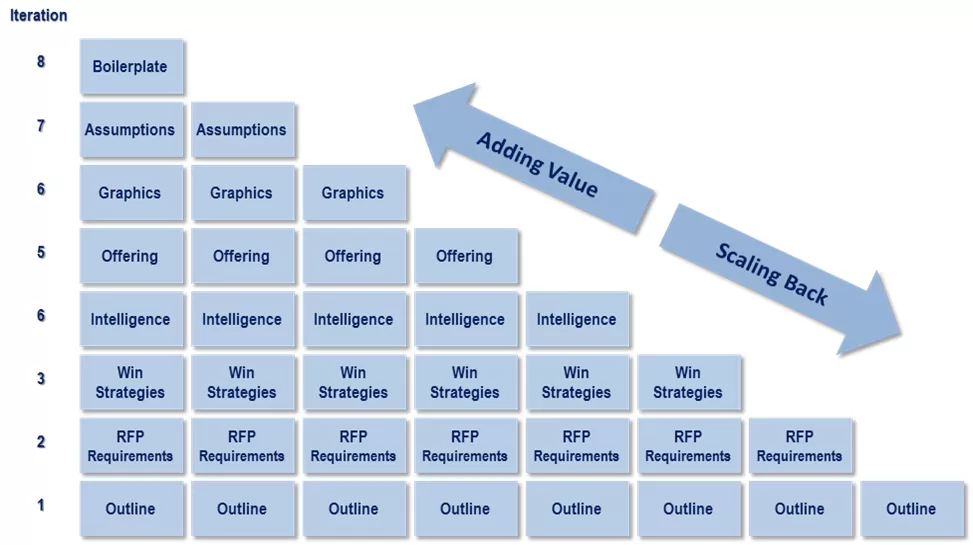 You add the most value when you do all the iterations, but if you don’t have the time you can scale all the way back to even just one iteration. You decide how to best balance schedule and resources against planning and performance. But if you need to scale back the amount of planning, this chart shows how to do it by skipping the things that add the least amount of value. Performing all of the iterations will produce a very comprehensive content plan. But for a large proposal, this
- 0 comments
- 3,639 views
-
Validating your Content Plan before you start to write: Prevents re-writing and editing cycles. Enables you to confirm that the approaches are correct before you start writing. Provides you with a reliable baseline to measure the draft text against. Validating the Content Plan is more important than validating the draft text. It is important to confirm that the Content Plan contains everything that it should, and that the instruct
- 0 comments
- 249 views
-
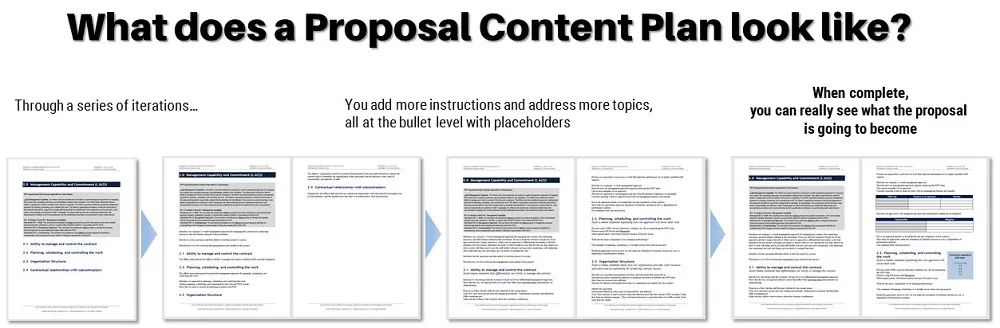 Proposal Content Planning is a methodology that is part of the CapturePlanning.com MustWin Process. The full methodology is part of what comes with a PropLIBRARY Subscription. Here is an introduction to Proposal Content Planning. When you are just getting started with preparing Content Plans for your proposals, you can put anything in them that’s helpful. You don’t need to get hung up on the wording. Anything you put in them will be better than nothing. As your experience and skills im
- 0 comments
- 4,568 views
-
The PropLIBRARY Course System uses just a handful of content types for all of the course content: Articles. Use this for text with graphics and links. It can used for a textbook topic or it can be a description and a link. We use it for repurposing the content from the PropLIBRARY website. The target for this content type is 500-1500 words, but it will support much longer lengths. Formatting is limited to what the web-based editor supports. Tables can be created, but are a pain. Fi
- 0 comments
- 367 views
-
You can accelerate your proposal quality validation efforts by identifying the quality criteria you want to apply to all proposals ahead of time. You can even turn them into checklists. If you provide an opportunity to create additional quality criteria that are specific to the pursuit, you can accelerate without watering down your criteria. This requires thinking through your standard quality criteria before you start your proposal. If you start a proposal without already having prepared y
- 0 comments
- 327 views
-
To facilitate your Proposal Quality Validation planning, we have prepared a set of sample quality criteria, allocated to key proposal milestones. Make sure you customize this list to reflect the specifics of the opportunity, your type of business, and the market. 1. Pre-RFP If you implement Readiness Reviews, then these items have already been validated. 1.1 The opportunity is worth pursuing 1.2 We know what evaluation criteria to anticipate 1.3 We have collected th
- 0 comments
- 651 views