Articles
-
How should you position your experience to get the best score? You may need to position things differently in different sections of the proposal where experience is relevant. Make sure you thoroughly tailor any experience write-ups you might be reusing to match the way you will be positioning it. You can’t be all things to all people. What matters about your corporate experience to the new customer? Don’t try to position against all of these that sound beneficial. Carefully select the ones
- 0 comments
- 492 views
-
 In certain service sectors, capabilities and corporate experience are talked about as if they are the same thing. While they are related, they are not the same. And they should not be written about in your proposals as if they are the same. A company can have experience in an area, but not have any capability in it. How’s that? Staffing. Resources. Infrastructure. A company may not have the other things necessary for experience to be a capability. Experience is evidence of a capab
- 0 comments
- 189 views
-
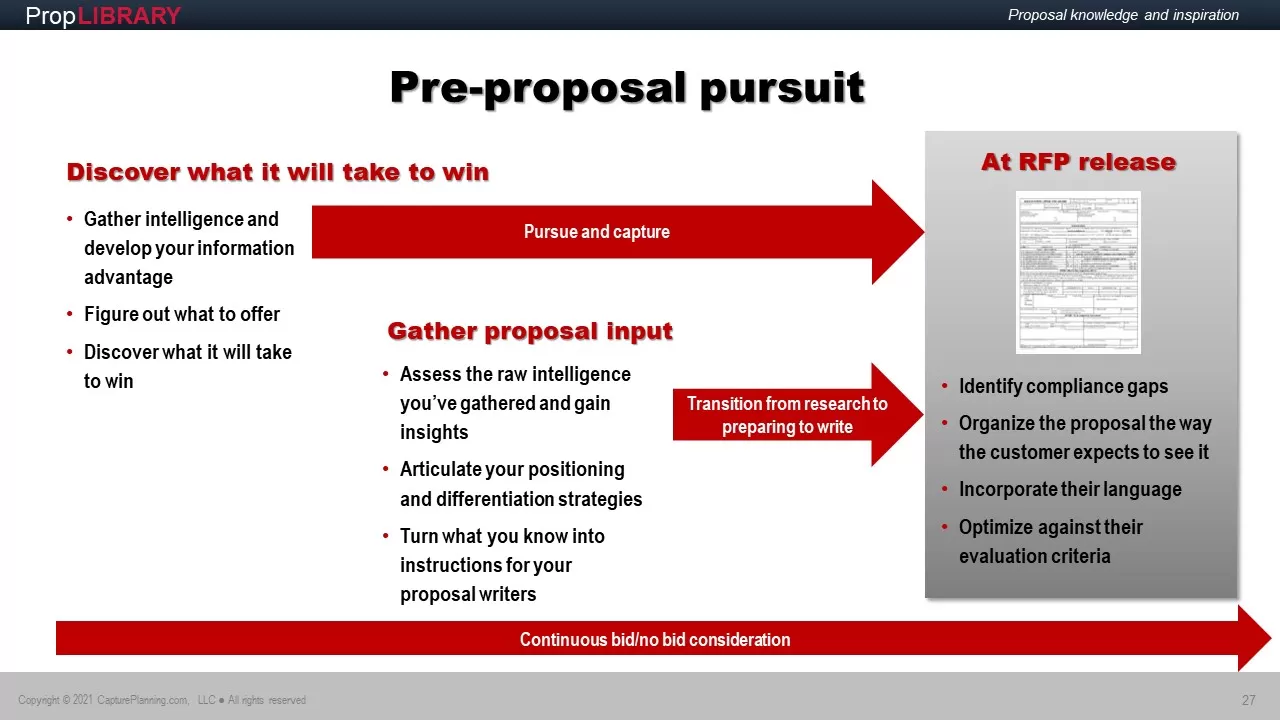 Before you are ready to start your proposal, it would be a good idea to discover what it will take to win. It's a bit hard to write a proposal based on what it will take to win if you can't articulate it. But before... Before you can articulate what it will take to win you need to... Transition to features Transition to screenshots Close it out
- 0 comments
- 288 views
-
 Here is an example of proposal writing for you to consider. I review a lot of proposals and see this style of writing all the time. In fact, a lot of people try to emulate it. How does this sound to you? Our company is based on the belief that our customers' needs are of the utmost importance. Our entire team is committed to meeting those needs. As a result, a high percentage of our business is from repeat customers and referrals. We would welcome the opportunity to earn your trust and
- 0 comments
- 6,968 views
-
 Sometimes people put a lot of time and energy into making sure their proposal tells their story. They craft their story with great care. They become attached to it. They often use up valuable page space leaving less to address the RFP requirements. The story the customer wants to read is the one about how great their future is going to be. And it’s a short story. It’s a tweet about the summary of the abstract of the short story. Who wants a lot of reading? TL;DR… The person reading t
- 0 comments
- 3,770 views
-
Customers clearly think that price matters. They are also concerned about risk. If the price is too low, the risk goes up. What they want are the features, but what they need is compliance with the specifications and anything they are required to comply with. Your best clue as to which of these matter the most is the evaluation criteria in the RFP. Look at how they evaluate each item and how much weight they give it. Then make sure that your offering and the points of emphasis in your prop
- 0 comments
- 363 views
-
 Proposal writing is not about finding the magic words that will somehow compel the customer to select your proposal over all other alternatives. It's really about understanding what the customer needs to see to reach their decision and then giving it to them. And yet most companies fail to do this. The most important skill for winning in writing is writing from the customer's perspective. Your proposal should not be about you, it should be about your customer and be written from their per
- 0 comments
- 12,409 views
-
 When we write proposals, we often don’t really know what the customer cares about. This is a big reason companies why talk about how great they are. It's easier to talk about yourself. The result is a proposal that isn’t what the customer wants, written in a way the customer doesn’t want to read. You can't win if there's nothing in your proposal that the customer cares about. Even when you have the best of intentions and put effort into discovering what the customer cares about, somehow whe
- 0 comments
- 8,246 views
-
 When the customer receives your proposal, what will they think? Nearly all the proposals I review are written about the company submitting the proposal. Is that what the customer wants to see? I can’t tell you how many hours I’ve spent discussing whether proposals should use words like “will” or “ensure.” Does the customer even notice? Are there things that matter more to the customer? The trick to figuring out how to say things in your proposal is to be able to see your proposal like
- 0 comments
- 11,556 views
-
 Writing an RFP is harder than writing a proposal. If you are a proposal writer and have never written an RFP, especially for something you need created or developed, you should try it some time. It is a great way to improve your ability to see things from the customer’s perspective. Even if you can clearly express what you want, doing so in a way that someone else won’t misinterpret is challenging. And most RFP writers are not experts, either in articulating what they want or in writing RFP
- 0 comments
- 6,593 views
-
 The proposal becomes part of the conversation when it responds to something the customer said, usually in the form of an RFP, and then gives them an opportunity to continue the conversation, usually by accepting your proposal. But there is more to it than that. When making the proposal part of a conversation is part of your strategy, you have to be the company that the customer would most like to continue the conversation with. That means you have to put things on the table to discuss in a
- 0 comments
- 4,993 views
-
 Customers ask for descriptions, even though that is not what they really want. They are not being sneaky, they just don’t know what to put in their RFPs, so they ask you to describe things they think are relevant to what they are trying to do. If you understand the decision they have to make, then you can address what they really need to know when you respond to what they asked for. When they say: Describe your company. They mean, “What can you do for me?” They also mean, “Can I tru
- 0 comments
- 7,539 views
-
 What value does the customer get from reading your proposal? Oh sure, they’re going to get what you are proposing, but if you’re responding to an RFP they pretty much already know what that is. And besides, if the RFP told you what to bid, then they definitely know what it is. Reading your proposal is a chore. The customer doesn’t even assign their best people to it. It’s a chore because it’s a mechanical task of making a selection based on matching criteria and following procedures. The ev
- 0 comments
- 8,519 views
-
 You don’t have to be a proposal specialist to win. In fact, a non-specialist can easily beat a specialist. All you need to do is have a better understanding of your customer’s needs and preferences. That is more important than your proposal writing skills. Far more important. If you do a good job at gaining an information advantage regarding the customer’s needs and preferences, you can often win, even though you did a mediocre job of putting it in writing. But if you don’t have an informat
- 0 comments
- 11,830 views
-
 This article is another in a series we've written on Doing Proposals The Wrong Way. They describe very powerful, but dangerous, techniques that turn the best practices on their heads. The most powerful proposal writing aligns what you are offering with the customer’s vision. The customer’s vision for themselves is about what they want to become. It tells you how they want to change. If you get their vision wrong, then you could very well be suggesting that they change in a way that is not w
- 0 comments
- 4,181 views
-
 Customers don’t see your company as a whole. They only see what you send them, the people they interact with, any products you install, and the results of your efforts. Before they meet you, they might hear about your reputation, but unless what you do is important enough, or widespread enough, they probably haven’t heard about you at all. When they get a proposal from you, they see what you’ve put in writing. And that’s it. All those unsubstantiated claims that you think are credible, they
- 0 comments
- 4,035 views
-
 The best way to win a proposal is to write about what matters to the customer. But there is another, even more powerful way to win. Unfortunately, it’s dangerous. If you don't get it exactly write, you'll probably lose. If you do, you'll probably win. While writing about what matters to the customer is what everyone aspires to, it is at best the second most powerful form of proposal writing. The most powerful form is writing about what should matter to the customer. Writing about what shoul
- 0 comments
- 4,728 views
-
 We’ve noticed a trend in proposal debriefs, where the comments are more and more likely to be based on black and white criteria like “did address” or “did not address.” Never mind whether what the proposal said made sense or is qualitatively better than what your competitors have offered. The criteria have been made objective so that the evaluation can’t be questioned. It’s been made black or white, with no protestable shades of gray. When this is the case, the evaluation is performed mecha
- 0 comments
- 6,464 views
-
 Most proposal introduction paragraphs are wasted space. They are written like the writer needed to get warmed up while figuring out what to say. And yet when the customer looks at your proposal, wondering what’s in it for them, it’s the first thing they read. It's the first thing they consider when deciding whether to read further and whether to accept your proposal. An ordinary proposal introduction won't add value or help the customer. They usually include a company's standard way of ta
- 0 comments
- 11,859 views
-
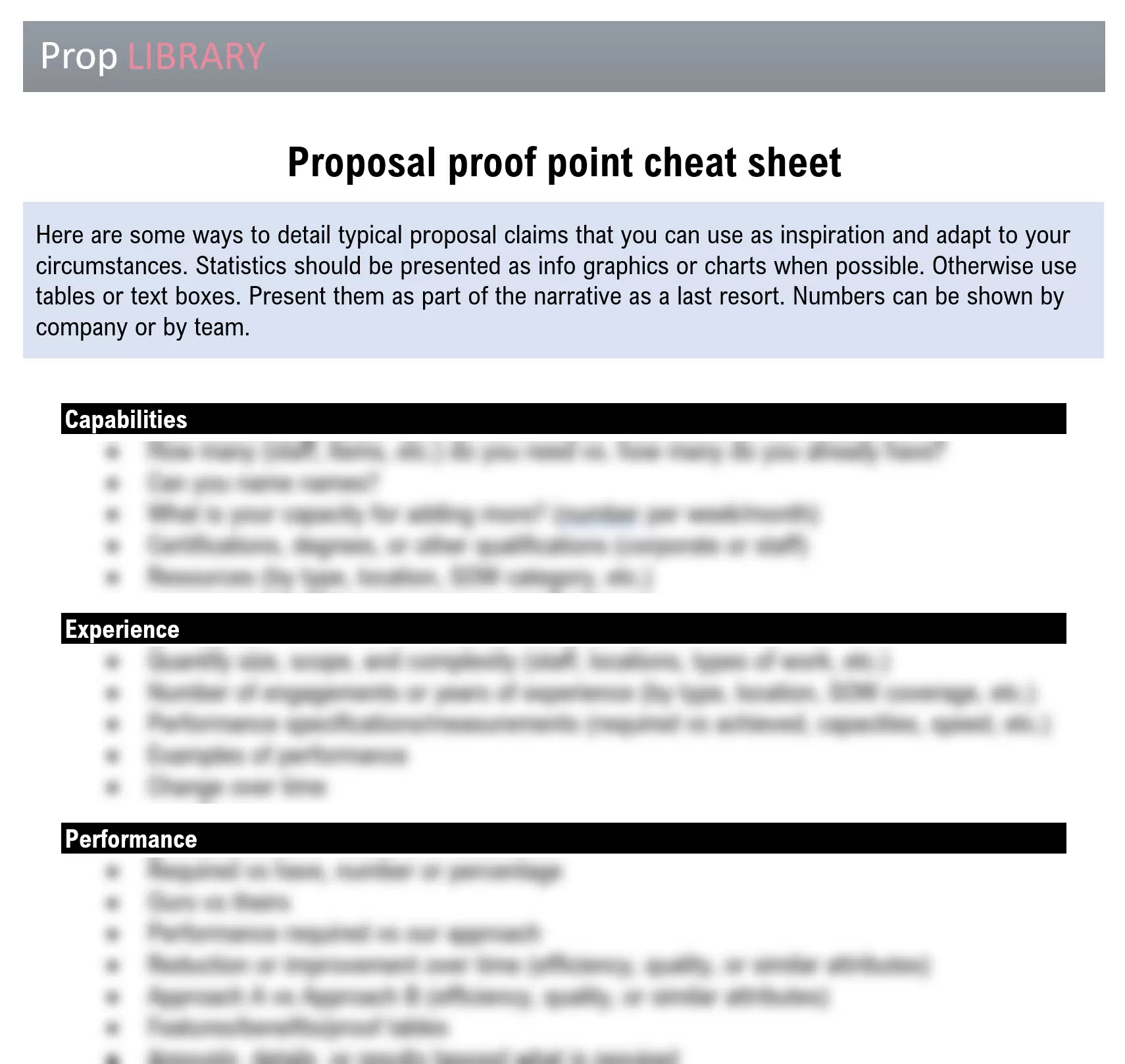 Here are 28 ways to detail typical proposal claims that you can use as inspiration and adapt to your circumstances.
- 0 comments
- 2,125 views