Articles
-
 You need more than an RFP or the customer’s specifications to write a winning proposal. Just think about your last proposal, and all the questions you had when you started writing. Then think about all the questions the customer might have about a potential vendor. You should easily be able to think of more questions than the RFP requirements will answer. The importance of knowing what you don't know Most people focus on objective, tangible things, like whether you’ve done certain thing
- 0 comments
- 1,675 views
-
 Normally I think that even looking at a past proposal is asking for trouble. You don’t need that kind of pain. You made mistakes you don’t even know about. A lot of them. In fact, based on what we see when we review proposals for companies, there were a lot of problems in them. Even the proposals that won. Why open those wounds? Two words: win rate. A small increase in win rate is worth a large investment. Do the math. But what should you do to improve your win rate? Looking at yo
- 0 comments
- 3,189 views
-
 Some things are vital for proposal reviews to be consistently effective, and other things depend on your circumstances. People mix them up all the time because they're focused on their circumstances. They're so focused on how they’re going to get the proposal done that they overlook that what they review is more important than how they review it. Changing your focus to what really matters means changing your whole approach. You can let your circumstances and judgment determine: How m
- 0 comments
- 3,421 views
-
When you get a proposal assignment, consider: Are you capable of performing the assigned task? It does no good to accept an assignment if you are unable to complete it. If you are not confident that you can complete the assignment on time and with quality sufficient to help win the proposal, then you need to speak to the Executive Sponsor or Proposal Manager. It is better to let people down while they have time to replace you than it is to accept the assignment and then be unable to co
- 0 comments
- 211 views
-
 Most businesses obsess over lead generation. Unfortunately they fail to realize there is something else that delivers 3-5 times the ROI. That’s right. They could be growing their business faster with fewer leads. It’s mathematical. And we have the proof. While we were doing a pipeline assessment for one of our consulting customers we discovered a remarkably simple mathematical relationship. But to understand it, you have to understand a little bit about the math that drives the business pip
- 0 comments
- 6,485 views
-
 Like color team reviews, I have never seen two companies conduct Black Hat reviews the same way. At a high level, a Black Hat review is a competitive assessment to address who the competition is and their strengths and weaknesses. Sometimes a Black Hat review scores your company and your competition against the anticipated evaluation criteria to determine who has what advantages, and what to do about them. At a minimum, a Black Hat review should help you discover how to best position your compan
- 0 comments
- 3,553 views
-
 Proposal specialists tend to obsess on building a process based on writing and reviewing. Pricing is an after-thought. What happens when you reverse that? What happens when you build the process around what it takes to produce a winning price proposal instead? What does the proposal process look like from the pricing perspective? What are the strategies and positioning that will drive the pricing? Is the intended offering price realistic and competitive? Is the pricing
- 0 comments
- 2,270 views
-
 Designing quality into a proposal means building a process in which defects aren't created. This is far superior to a process that allows defects and then tries to find and fix them. Designing quality in doesn't just mean making sure you get it right the first time, it means eliminating the possibility of defects. It is a very different approach from creating a draft and then inspecting it. Most existing proposal processes are based on creating a draft, then inspecting it, then re-doing i
- 0 comments
- 4,874 views
-
 I love starting off our consulting engagements by doing a pipeline assessment because it quantifies the reality of things and gives us both a better understanding of the true impact of the improvements we make together. It clarifies goals, budgets, and how to allocate resources. But the best part is that everything we do can be compared to a set of expectations designed to produce a measurable return on investment. But there are limits to what a pipeline assessment can tell you. This articl
- 0 comments
- 4,120 views
-
 We usually think of a proposal as a tool to close the sale. Does that mean it’s an ending to the conversation you’ve been having with the customer? Or is the start of another conversation? What if you go into the proposal and you haven’t had any conversation with the customer? Can you have a conversation on paper? How does that work? We discover the customer’s needs, we brainstorm solutions that match our capabilities, and we offer them to the customer for consideration. We really want to a
- 0 comments
- 5,284 views
-
 Somebody actually said the following in our discussion group on LinkedIn: Saying process is a crutch is like saying education is a crutch. There are definitely ineffective processes, and most processes can be subverted or weakened through lack of management endorsement or oversight. But that doesn't make all processes bad. The best processes add value. To beginners. To experts. To the executives. And to stakeholders especially. If a process is being used as a crutch, then it needs to
- 0 comments
- 5,176 views
-
 Most people overlook the best ways to speed up their proposals. They focus on having a faster start-up, having a re-use library, or automating document assembly. Or they look for AI to write their proposal for them, ignoring how that will never be competitive. But they overlook two critical approaches. What causes proposal slack time? Most of the slack time in a proposal happens when you are ready to take the next step, but can’t because you don’t have the information you need. So you s
- 0 comments
- 7,056 views
-
 Most proposals start off with outlines, compliance matrices, and kick-off meetings. If they’re smart, they plan the content before they start writing. Then they get writing. When they have a draft, they hold a review, usually called a Red Team. Then they do some more writing and editing, before going into final production and submission. They’d be better off if instead of starting by planning the content, they started by planning the review. Only it’s not the logistics of the review th
- 0 comments
- 5,552 views
-
 In business development, thought leadership is really about trust. That is why thought leadership is best demonstrated, and why simply claiming it can backfire. Thought leadership is about who you trust to guide you through the issues and find solutions. If you want to be a “thought leader,” you should: Show insight that helps your customers achieve their goals in ways they may not have thought of on their own Demonstrate customer service before the project even starts Do you
- 0 comments
- 4,452 views
-
 There are only three ways to win a proposal. All the strategies and techniques you can think of fit into these three. The three are fundamentally different. Understanding that gives you an advantage when it comes to figuring out the winning strategy. Most companies just muddle through, with strategies based on any one of them at any given moment. This gives you an opportunity to gain a competitive advantage by understanding the implications of how they apply to you. If you understand which
- 0 comments
- 4,409 views
-
 There is a clear line. If your company crosses it before it has institutionalized a winning business development process and culture, it may never be able to recover. Most businesses drive right off the cliff because they are more concerned with keeping the car going than where they are steering. The problem starts when companies are in their startup mode. Everyone is wearing multiple hats and figuring out things as they do them. They don’t have the capacity do something extra like formaliz
- 0 comments
- 6,690 views
-
 If you think that filling your pipeline should start by identifying leads, you’re wrong. Filling your pipeline starts by identifying where leads come from. If you start with leads, then you start after the customer knows what they want and has probably already written the RFP. If you start with where leads come from, then you have a chance to help the customer figure out what they should want and can even help them write the RFP. Figuring out where leads come from isn’t even the first step.
- 0 comments
- 7,966 views
-
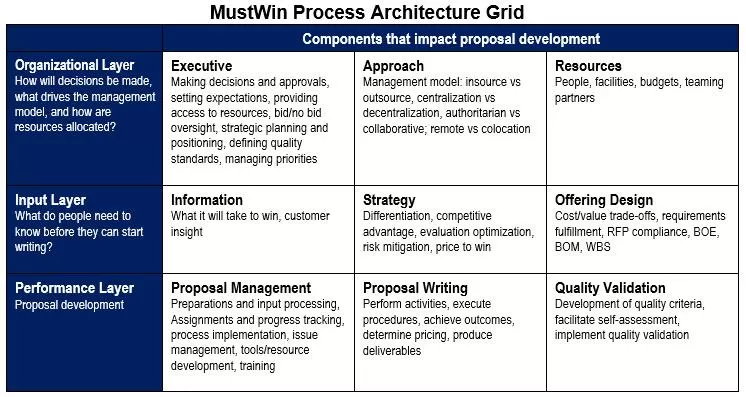 Process implementation is only one part of one component of everything that goes into enabling an organization to maximize its win rate. The chart above provides an architecture that can help you put the proposal process into context. This architecture matches the environment proposals operate in better then by grouping things by organizational boundaries like business development, capture, and proposal management. The issues shown in the chart have as much impact on your success as how you
- 0 comments
- 411 views
-
 1. Strategic Leadership My favorite way to distinguish leaders from managers is that leaders determine what the goals should be and managers work to find the best way to achieve the goals. If you need someone to improve something, you need a manager. If you need someone to reinvent something, you need a leader. One is not better than the other. Both are needed for a successful organization. But to win proposals you need to differentiate. You can’t be the best unless you are different. Y
- 0 comments
- 3,921 views
-
 If you write your proposal by simply following the RFP, you will not only create an uncompetitive proposal, you will create a proposal that is boring. It will be boring to the customer, boring to your reviewers, and boring to write. I have reviewed a lot of boring proposals. Boring proposals are often a result of people overly focusing on RFP-compliance and not on being extraordinary. Compliance is good. But not good enough to win. The key to winning is in how you turn compliant prop
- 0 comments
- 7,490 views