Articles
-
 A proposal process is not enough to maximize growth, no matter how good the process is. A good proposal process will mostly lose. A great proposal process will make you competitive, but even that doesn't mean winning most of what you bid. Consistently producing winning proposals and doing it in volume requires more than just a process. In fact, being at the top of the competition depends more on going beyond your process than perfecting your process. What is beyond your process? A shared set of
- 0 comments
- 18 views
-
 In most companies, proposal development is the most immature part of the company. But they don’t realize it because they’ve bought into myths that enable them to think all that work they’ve put in amounts to more sophistication than it really does. Often what they do is different from what they say they do. Because of the myths that people have bought into, management practices that would not be tolerated in any other part of the company become expected as the norm in proposal management. These
- 0 comments
- 2,885 views
-
 You can't follow the steps to create a great proposal, because the steps are different every time. They aren't even steps. At best we talk about phases. But even those change, overlap, or get redefined every time. That's why most companies really just have a way of doing their proposals that isn't legitimately a process. If a process requires a certain person to run it, it's not really a process. Writing a winning proposal is really based on a flow of information, from lead to submission. Unfort
- 0 comments
- 5,059 views
-
 People bring their expectations to work with them. People form expectations while at work. Expectations run in every direction, between every stakeholder. Humans generally do a poor job of communicating them, and an arguably worse job of fulfilling them. It is a wonder that anything ever gets done. We can do better. What if expectations were communicated more clearly? And accepted? What could we accomplish if we fulfilled all of our expectations for each other? What stands in the way of this? P
- 0 comments
- 1,563 views
-
 If you are a contractor, I’m willing to bet that not only is your mission statement ignored, it’s probably just plain wrong. Take a look at these mission/vision statements from three of the largest U.S. Government contractors: We solve complex challenges, advance scientific discovery and deliver innovative solutions to help our customers keep people safe. Connect, Protect, Explore and Inspire the World through Aerospace Innovation. One global team creating trusted, innovative solutions to mak
- 0 comments
- 5,266 views
-
 If your goal is to provide reasons for the customer to select you (what themes are supposed to provide), then maybe you should think less about the features in what you offer and think more about what matters to the customer. What should drive your win strategies are not simply the advantages you think you have, but rather the advantages that matter to the customer and affect your evaluation score. Here are 11 customer-centric theme that should drive your win strategies: What is the nature of yo
- 0 comments
- 520 views
-
 If you leave your win strategies until the end of your proposal, after you’ve got it written as if win strategies are some kind of icing on the cake, then you need to understand why your good proposal is going to lose. To end up with a great proposal instead of a merely good one, you need the right strategies. Before you can develop the right strategies, you’ll need to have developed an information advantage. And once you have your strategies, you’ll need to articulate them in your proposal. Peo
- 0 comments
- 10,472 views
-
 After you identify what things matter to your customer, you can start exploring how they matter to the customer. Then you can choose what to focus on in your proposal. That’s when you find that you have choices, and those choices are what become your bid strategies. Below we show some of the things that matter to customers, explore how and why they matter, and discuss how you can use them to create bid strategies and competitive advantages, and articulate why the customer should select you. Pric
- 0 comments
- 9,656 views
-
 The habits that companies need to develop are different from the personal habits that people develop. Companies focus on things like policies and procedures, but habits usually don’t make the list. As a result, the habits they develop are usually the bad kind — the ones you fall into in the absence of having good habits. So we thought we’d take a look at what the good habits should be. The habits that a company needs relate to the things they need to do and achieve, but are different from the pr
- 0 comments
- 8,839 views
-
 I like to think of it as the “other people” problem. Proposals would be so much easier if you didn’t have to work with other people. If they would just do what you need them to do… But then again, without them you could never create a proposal larger than yourself. Winning big depends on solving the "other people" problem. At work we tend to think that working with other people is just a matter of management and leadership. But proposal specialists often (usually?) work with people that they h
- 0 comments
- 2,648 views
-
 Some companies are built on formal hierarchies, with decisions made by someone in charge. Other companies are consensus driven and work through collaboration. Neither approach is right or wrong. Depending on the circumstances, one can be a better fit. However, picking an approach that does not match the culture of the company is doomed to failure. Rather than deliberate over how to determine which approach will work in a given environment, there is a much simpler approach. If you have to ask, th
- 0 comments
- 2,165 views
-
 Proposal teams are great at filling voids and getting things done without proper direction. They’ll complete the proposal no matter what. And that’s part of the problem. If they have to, they’ll water things down to gain acceptance. If they have no choice, they may even fake it. They are quite good at making the most of their circumstances, but they can’t read minds, and their authority is limited. Make things clear and your people will work more quickly and be better focused on winning instead
- 0 comments
- 4,317 views
-
 Who do you need on your proposal team? The place to start is with what activities need to be covered and what skills are needed. The easiest way to account for all the activities and corresponding skill requirements is to categorize them by the roles that people play in proposal development. Proposal development roles We prefer to define roles functionally. It doesn’t matter how many people you have doing the work, as long as you have every function covered. On a small proposal you might have on
- 0 comments
- 13,291 views
-
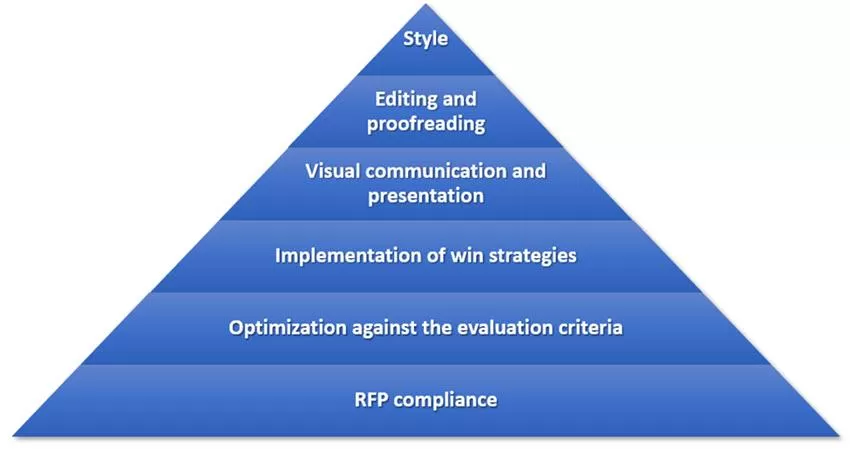 Understanding how to set your priorities is key to winning proposals. There are far too many things you want to do before the deadline than are possible to achieve. If you do not have the right priorities, you will waste time and effort on things that have a lesser impact on your probability of winning. Ideally, your priorities will perfectly match the impact of each item on your win probability. But calculating win probability is not always possible. That’s where Maslow’s Hierarchy of Needs co
- 0 comments
- 5,328 views
-
 Capability statements and white papers are so common, customers hardly notice them. When a customer gets one, what do they actually do with them? Do you really think yours is so special that it’s going to be any different? If you want it to be special, it has to be more. It has to be exceptional. And to be those things it has to start by being different. It has to be more than merely the same but better. Replace the idea that you want to tell the customer about you and your offerings with a purp
- 1 comment
- 626 views
-
 Are most of your interactions with potential customers these days in writing? Relationship marketing is about providing support and building trust. This is still true when your relationship is conducted by writing. When communicating with potential customers in writing, are you giving them value or just asking for things? What can you give in writing that helps a potential customer? They don’t have to cost a thing to give, but can still have value to the customer. How about Explanations Compar
- 0 comments
- 4,410 views
-
 I know it’s fun to complain about the boss, but if you want to get things done, you need to think like the boss. There are reasons why you are encountering friction. It’s not as simple as they are micro-managers or ignoring you. You can use this list to anticipate their concerns and improve the chances that they’ll listen to your concerns. Think of it like a proposal. You need to translate why what you want is in alignment with their goals. Here's why your executives won’t list to you: You’re no
- 0 comments
- 7,498 views
-
 Most people are a mix of all three perspectives. This is especially true in organizations that don’t have someone assigned to each level. You will substantially improve your value if you can at least look at every issue from all three perspectives. People who like the comfort and security of staying within the box of their chosen level are not people needed to drive the organization to win. So what we’ve done is start with the Executive, Manager, and Worker’s perspectives, and then applied them
- 0 comments
- 4,959 views
-
 Congratulations! Either you got promoted or have started your own company. You’re an executive with profit and loss responsibility now, and must grow your business. You probably have some experience with business development, sales, or proposals, but being in charge of it is another matter. That’s okay, because like most executives, you’re confident you can make the stretch. My goal in writing this is to help you avoid falling into traps that look rational, but will weaken your competitiveness.
- 0 comments
- 6,731 views
-
 The purpose of this article isn’t to tell you how to be an executive. You already know that. And if you don’t, you’ll be hearing soon from all the needy voices. The purpose of this article is to share some insights and lessons learned related to business development, capture, and proposals that can help you grow your organization and be more prosperous. This article is not about the details of those functions, but what those functions need from their executive sponsor. This isn’t obvious stuff,
- 0 comments
- 1,425 views