Articles
-
 Proposal management is needed when you want to go after contracts that are bigger than yourself and you have to work through difference between managing a small proposal and managing a large proposal. Proposal management means answering questions like: Who issues proposal assignments and who is responsible for fulfilling them? Where do you draw the lines? On the organization chart? Between one person's role and another? How do you allocate proposal resources and perform scheduling? Who defin
- 0 comments
- 23,276 views
-
 When you’re a small business that’s stretched thin, can’t afford specialized resources, and everyone is wearing multiple hats, it’s easy to be intimidated by larger competitors with more employees and assets. But if you match your strengths against their weaknesses, you can consistently beat them. Here’s how: Have Stronger Relationships. Sure, big companies have a lot of staff, but they also have to be everywhere at once. If relationships are key to your line of business, then focus on developin
- 0 comments
- 10,061 views
-
 We like to think that when someone didn’t fully complete an assignment on time even though they accepted it, it was just a problem with motivation. It’s easy to throw shade. But experience shows us that it’s more complicated than that. It’s also easy to assume there’s an easy solution, like better deadline “enforcement” by The Powers That Be. Or that people should “just follow” the process. But experience shows us that it’s more complicated than that. The key to being able to make improvements
- 0 comments
- 1,245 views
-
 Most people calculate proposal efficiency the wrong way. They calculate it based on how much effort they put into their proposals. This is based on the assumption that less effort always makes things more efficient. And it happens to be a wrong assumption. Efficiency is defined by maximizing productivity with the least amount of wasted effort. Measuring proposal efficiency The productivity of proposal effort is best measured by the amount or percentage won. This means that the efficiency of prop
- 0 comments
- 2,105 views
-
 Your proposal should not be about you. Compare these two approaches to proposal writing: Our approach is to do this and then we do that. We can do this well because we are so qualified. You will get all this and as a result things will be much better for you and it will be easier for you to do so much more. If you’re talking to a salesperson about something you need, which approach do you want to hear? What does the customer really want? How should you say things in a proposal so that it's wr
- 0 comments
- 1,975 views
-
 Why do so many businesses set themselves up to fail? Just because you are capable of doing the work a customer needs does not mean that you matter. If you don't matter, the only way you can be competitive is on price. The closer you get to a commodity, the more important price is. With a commodity, every vendor is providing the same thing and which vendor you get it from does not matter. The closer you get to a complex solution or services, the more price gives way to credibility and value. If y
- 0 comments
- 10,044 views
-
 How do you go about influencing the customer’s RFP to give your company an advantage? When you start thinking about it and peeling back all the layers, it can seem quite complex. There's a lot to consider. And where should you start? Here is a simple formula that’s easy to memorize and can help you cover all the important aspects of the problem. Who. Who is the customer? Who is the decision maker? Who needs help? Who can make changes to the RFP? Who is playing the contracts role? Who is in charg
- 0 comments
- 435 views
-
 The proposal process is not about efficient repetition. It is not even primarily about managing the steps that go into creating a proposal. The proposal process is about problem solving, starting with figuring out what it will take to win. It is about solving the problems that arise while trying to win your proposal. Each time you execute the proposal process you will encounter new, unanticipated problems that mostly result from the customer asking for new things, or asking for old things in new
- 0 comments
- 3,094 views
-
 Most proposal processes, whether they realize it or not, are about the flow of information. You could create a proposal process just by looking at how information needs to be discovered, transformed, and handed off from one person or step to the next. It works even better if you start at the end, with a winning proposal, and work backwards to define the flow of information needed to arrive at it. But it can get pretty complicated, especially when you take the enormous amount of flexibility requi
- 0 comments
- 4,991 views
-
 Proposal theme statements are how you articulate why the customer should select you. They deliver your message, tell your story, and flow through the proposal document. They provide the big picture and define what your proposal means. Themes may be incorporated into headings, tag lines, text boxes, or just be the main point of a paragraph. They are the message and there are many ways to deliver it. You need to be able to articulate your proposal win themes so that you can build the proposal arou
- 0 comments
- 34,841 views
-
 A sound proposal process not only increases efficiency and improves win rates, it is also one of the few things that can give people working on a proposal hope that the next proposal won't be so bad. Proposal specialists make everything about the process. And that's a good thing. Until they take it too far. The problem isn't having "too much process." It's growing your process in ways that reduce effectiveness. The proposal process must be effectively implemented. This is where people struggle.
- 1 comment
- 1,745 views
-
 Take a step back from what you think you know about proposal management, if only for a minute. What you can learn from this grid is what information people need, and where to create information products that flow it to them. But studying it can also provide some other insights: Process, tools, and techniques combine and have a big impact on your ability to flow information and manage issues. It’s easy to fixate on a problem in the moment and think a tool can solve it. But your needs change over
- 0 comments
- 1,106 views
-
Everything I needed to know about proposal writing I learned from writing the introduction paragraph
As soon the introduction to a proposal is written, it becomes obvious whether it's going good or bad. Right from the start. The first draft of the introduction tells you a lot about the maturity of a company's proposal process. Writing a good introduction demonstrates what you know about what the customer really wants. If you can't write that, then you don't know what you're proposing. And if the introduction consists of nothing more than information that can be found in the RFP, you know that t- 0 comments
- 4,196 views
-
 Take a moment and ask yourself why you're interested in reducing the amount of proposal writing. It could be because you're out of time. Or have strict page limits. Or have other priorities and want to reduce the effort required by a proposal. This is where I'd normally jump in with an ROI calculation that shows that the impact on your win rate of doing a proposal well makes it mathematically worth it. However, today I'm going to skip that and take an unjudgmental look at what it takes to reduce
- 0 comments
- 4,775 views
-
 Each and every paragraph in your proposal should make a point. Every sentence within those paragraphs should have its own point. And those points should not be about you. They should not simply describe. They should never make unsubstantiated claims of greatness. You should provide the information the customer needs, while pointing out why you are the customer’s best alternative. But what should you talk about to make those points? How do you go beyond answering an RFP requirement to make your p
- 0 comments
- 3,849 views
-
 What can you expect? You can expect more. We’ve added a community on top of the massive amount of content we’ve created. We’re also opening up our platform to other authors. So over time you’ll see a lot more online training and events posted. Service providers, consultants, and trainers will be available to you. All of it is delivered in an updated, easier to use interface. This was a massive refresh. The online training has also been updated, and the downloads are more accessible. An all-new e
- 0 comments
- 1,366 views
-
 In a past life I helped a company create a new proposal department. The company was part of a billion dollar government contractor. They had a history of business units not accepting process guidance from the proposal group. It’s not an uncommon problem. Does it sound familiar? The old proposal group kept saying things like, “If they’d only submit their drafts on time” or “if they’d only listen to us.” What they meant was “If they’d only do what they’re told.” They thought the solution was for s
- 0 comments
- 1,122 views
-
Within the MustWin Process Architecture we divide the organizational layer into the following areas: Executive, Approaches, and Resources. The organizational layer forms a context that impacts your ability to win bids. But it can’t necessarily be accounted for as inputs to the process. It’s not part of the process flow, but it impacts every step of the process flow. It is roughly analogous to style in writing, only it’s the management style of the environment your process operates in. Your win
- 0 comments
- 167 views
-
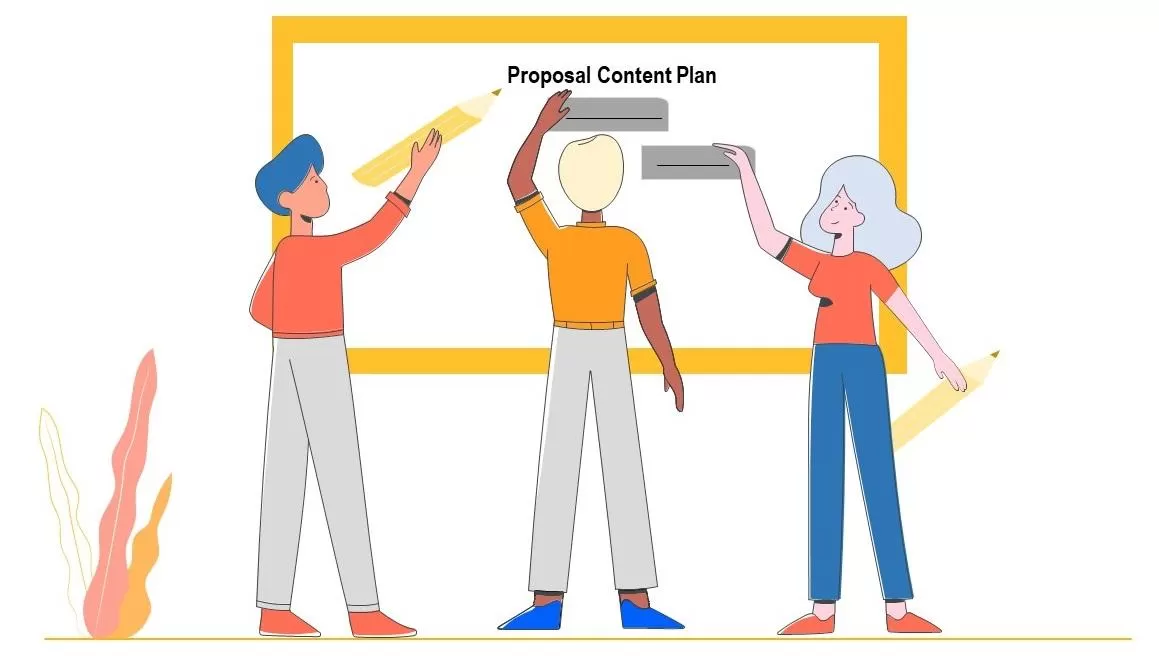 What you should write about? How should you present it? How do you know if it's correct? Before you jump into proposal writing, you need a plan. And you need to validate that plan to prevent rework. Why this goal is important If you think the best way to figure out what to write about in your proposal is to start writing, you may be making a colossal mistake. The mistake is that you’re skipping the part where you “figure it out.” You are thinking by writing about it. Responding to an RFP is not
- 0 comments
- 497 views
-
 Nearly all of the examples of selling in writing that we see in life teach us the wrong ways to write for proposals. From the ads on TV and the junk mail we receive, to the ads in publications. Even the materials handed to us by other companies are written completely wrong for proposals. And yet, when people sit down to write a proposal, they can’t help but emulate what they’ve seen when others try to sell in writing. Even what we learn in school about writing is wrong for proposals. When you wr
- 0 comments
- 4,019 views