Articles
-
 One of the most important things to realize about proposal writing is that it is not about you, your company, or even your offering. It’s not about telling the customer anything. It’s about the customer, their decision, and what they need to hear to make it. It’s hard to turn your brain inside out and backwards to articulate things that the reader wants to hear instead of what you are trying to say. It is impossible to do this if you don’t know your audience. To better understand your
- 0 comments
- 10,629 views
-
 What will a 1% change in your win rate return? If you don’t know, you really need to gather the data to calculate it. Because small increases in win rate are often worth considerable effort. In fact, increasing your win rate will often net a better ROI than chasing more leads. Once you’ve done the math and found your motivation, then you have to figure out what to do to improve your win rate and reap the promised ROI. To help you out, here are nine places to consider investing in to increa
- 0 comments
- 6,887 views
-
 The best way to accelerate a proposal is to lay the groundwork for winning in each step, so that the next step has what it needs. It does not come from automating or accelerating doing the ordinary. The goal is not to submit a “good enough” proposal, it’s to win them all and turn proposal writing into a profitable activity instead of a necessary evil. To achieve this, each step has to add value that the next step can build on. Here are eight examples: You can improve the efficiency of your
- 0 comments
- 4,736 views
-
 Proposals should be meaningful. But what does that mean? The best practices say that proposals should address all of the customer’s “hot buttons,” but what exactly are they? And about those win strategies and themes… where are they supposed to come from? We’ve been working for a couple of years to bring structure to helping you figure out what to focus on in your proposals. We generally advise people to focus on what matters to the customer. That’s bit easier to define than “hot buttons.” B
- 0 comments
- 10,999 views
-
 It’s easy to get overwhelmed when thinking about all the things you could do to try to improve your win rate. Where should you start? What makes this complicated is that the answer is different for every single company. Your strengths, weaknesses, and issues are different from others. The nature of your offering and who your customers are is different. What you should focus on to increase your win rate will be different from everyone else. But there are some issues that most companies
- 0 comments
- 5,310 views
-
 These tips are not about doing the same things a little better or more efficiently. They are not about which steps you should follow or which steps you can leave out. These tips are about changing the fundamentals to maximize your chances of winning with the resources that you have. 1. Figuring out what to write takes longer when you do it by writing and re-writing. If you jump into writing your proposal and then review it, you’ll find you overlooked things. Or you’ll find that it’s
- 0 comments
- 6,115 views
-
 Most of the proposals companies ask us to review have one or more of these issues. This means that most proposal writers have one or more of these bad habits. Simply fix these bad habits and you will make a dramatic improvement in your proposal writing. Once you’ve broken the habit, you can flip each one around and find a best practice hiding inside. Don’t state a universal truth by way of introduction. Avoid the temptation of starting off by saying something that is obviously and univ
- 0 comments
- 11,342 views
-
The following lists of proposal quality considerations have many uses. They can be used to replace review teams. They can be used to enhance review teams. They can be used as checklists by writers and reviewers. They can be used to define proposal quality. The checklists below are quality assurance checklists and not procedure checklists. Instead of telling you what to do, they ask whether you have achieved what you should have. They are intended to be used to assess whether what is created
- 0 comments
- 358 views
-
 The customer is more than one person. And different people have different perspectives. Developing a reliable relationship with the customer means interacting with as many levels and stakeholders as you possibly can. Here are some areas to focus on. Who to reach out to Each of these requires a different strategy. Each has different needs, priorities, and expectations. Each has a different perspective and can be a source for different information. All are worth contacting and getting to kn
- 0 comments
- 235 views
-
 I continue to be fascinated by how similar really bad proposals tend to be. They all make the same mistakes. And even if you follow good processes and do the right things, when the writing is that bad it can prevent you from winning. So I’m going to take a step back from writing about what it takes to submit a great proposal, and just focus on how to make sure your proposal writing is not awful. If you just stop doing these six things you can make a huge improvement in your proposals:
- 0 comments
- 13,800 views
-
 It’s important to be able to define proposal quality if you want to make sure that the proposal you develop reflects it. We define it as a proposal that reflects what it will take to win. We define what it will take to win as part of our process, reaching all the way back before the RFP is released so that the questions we ask and information we gather enable us to say what it will take to win. We use Proposal Content Planning to bring what it will take to win together with the other things
- 0 comments
- 12,523 views
-
 A key part of winning in writing is having the ability to write from the customer’s perspective instead of your own. Not everybody can write from someone else’s perspective. It turns out that seeing things from other perspectives can also help with other parts of the process. Here are five different ways of looking at your pursuits and how they impact your ability to win: The forward perspective. Looking forward is about anticipating and preparing for what to do next. It is about startin
- 0 comments
- 6,407 views
-
 Sometimes the world is just too big. It’s full of customers, but finding them is like playing the game, “Where’s Waldo?” And just like in the game, you need a strategy for finding your customers. You only have so much time and resources to put into the search. But unlike the game, you have to capture sales from Waldo. And it’s competitive. You may find him, but that doesn’t mean he’ll become a customer. When the game is business development, it’s not just about finding as many Waldos as you
- 0 comments
- 4,474 views
-
 An effective proposal group is more than just process and tools. But how do you assess its effectiveness? There are techniques and best practices, but what are the issues that impact its effectiveness? Here are five focus areas that reveal when you have things holding you back from maximizing your effectiveness. There are different ways to correct or improve things. But you must know what the issues are before you can select the right solution. Assuming the solution before you really under
- 0 comments
- 3,482 views
-
 What makes a great proposal process isn’t the steps. It’s not even the functionality. It’s the ability to anticipate problems and maximize the effectiveness of contributors. The questions below won’t tell you what steps you should have. They won’t even tell you what to do. But they will point out when you need to change because you have problems that aren’t being addressed by your process. If a particular individual is required to execute the process, you do not have a process. You have
- 0 comments
- 3,041 views
-
 One of the key goals of the MustWin Process is to design your proposal around what it will take to win. It starts with Readiness Reviews to help you collect intelligence about the customer, opportunity, and competitive environment. Then you need to assess the intelligence you've gathered to determine what it will take to win. This assessment gives you what you need to incorporate what it takes to win into your Content Plan and to turn it into criteria that can be used to validate that the finish
- 0 comments
- 6,985 views
-
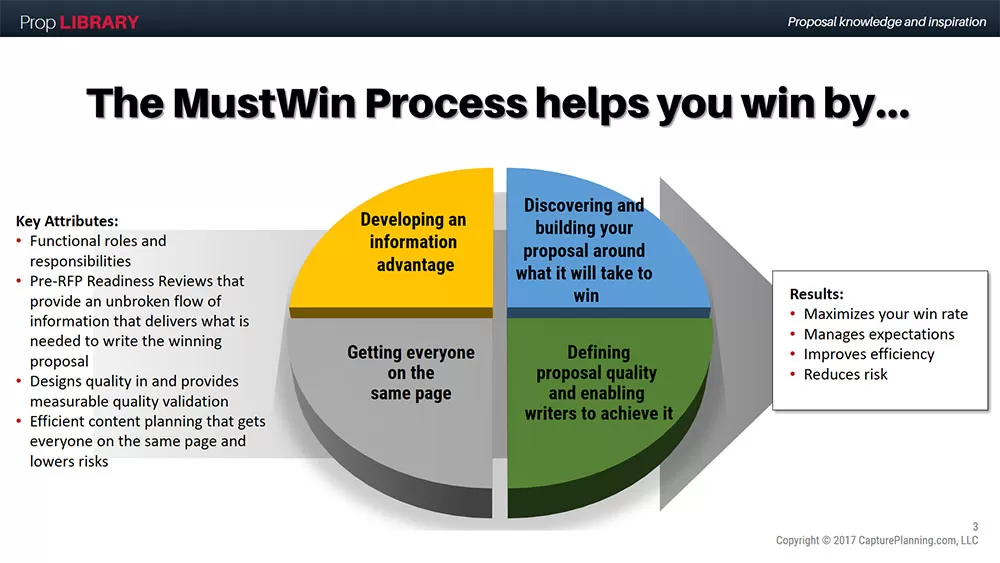 Getting everyone on the same pageWhen people working on proposals are pulled in multiple directions and all have different goals and different approaches to achieving them, you’re not going to maximize your win rate. Getting everyone on the same page involves more than defining roles and responsibilities, steps in the process, and having good assignment management. It requires having expectation management throughout the process. It requires that all these things be integrated into the process s
- 0 comments
- 6,668 views
-
 Our normal advice for beginners about how to format their proposals is to not make things worse by exceeding their capabilities. An overly ambitious layout can slow you down, introduce errors, and distract you from perfecting your message. We generally recommend that your goal should be a simple and elegant layout. But that’s our advice for beginners. If you are capable of reliably and efficiently producing advanced layouts, then you still need to give it some thought. The point of the pr
- 0 comments
- 10,253 views
-
Use the following as inspiration for your questions. The exact wording will depend on your circumstances and who your customer is. And don't forget... you can also ask for a debrief for a proposal that you won! Basic questions: Who won? How many bids were received? What was your overall score? Was your score close to the top or close to the bottom? What was the winner’s score? Did the winner have the lowest price? Did the winner have the highe
- 0 comments
- 233 views
-
All proposals represent change for the organization considering them. This is true even if you are the incumbent and aren’t really proposing any significant changes in approach. There will still be incremental changes to account for. All proposals can add value through change management practices. This is true whether the changes are explicit, with the customer expecting change, or if the customer either hasn’t considered or isn’t concerned with change. They may not think the project needs
- 0 comments
- 220 views