Articles
-
HAPD Week 7: Pink Team Prep, Review, and Recovery All bold red fonts are links. Monday, 06-May-2019 Final Pink Team editing - we'll make the final edits to the pink team content plans - pens down is 2:30 PM ET Break before mid-term - we'll have a break before the mid-term exam begins from 2:30 PM ET - 3:00 PM ET Mid-term exam - the mid-term exam begins at 3:00 PM ET and closes at 5:00 PM ET. There are two parts - part 1 is multiple choice and part 2 is a short
- 0 comments
- 454 views
-
HAPD Week 6: Path to Pink Team All bold red fonts are links. Monday, 29-April-2019 Module 6.1 Introduction to Writing Past Performance Results - we'll begin completing part 2 of the measles charts, which focus on the performance evaluation portion of Section M Monday is a half-day in the war room - afternoon is a remote work option Tuesday, 30-April-2019 Dan Marsh, COO of Hinz Consulting, will be presenting an overview of Hinz Consulting and best practices
- 0 comments
- 949 views
-
HAPD Week 6: Path to Pink Team All bold red fonts are links. Monday, 29-April-2019 TBD Tuesday, 30-April-2019 TBD Wednesday, 23-April-2019 TBD Thursday, 25-April-2019 TBD Friday, 26-April-2019 TBD Quiz and Discussion Week 6 Quiz - TBD Week 6 Discussion - There is no discussion this week. Where to find the Final DOE ORISE solicitation The ORAU RFP and final DOE ORISE solicitations have been released (O
- 0 comments
- 1,028 views
-
HAPD Week 5: DOE ORISE Final RFP and Proposal Schedule All bold red fonts are links. Monday, 21-April-2019 John is presenting a review of the Rapid Proposal Writing presentation (review for the mid-term exam in Week 6) on Monday at 9:00 AM ET - 10:00 AM ET The ORAU RFP and DOE final RFP have both been released - see below for links. We will be reviewing the RFP and planning our next steps on Monday. Our first major milestone will be the Pink Team Review. Dead
- 0 comments
- 1,039 views
-
HAPD Week 4: DOE ORISE Win Strategy and Proposal Plans All bold red fonts are links. Monday, 15-April-2019 to Wednesday, 17-April-2019 We continue Module 3.2 Intro to Pre-RFP Planning and we will be finishing our proposal schedule, which is posted here. We will develop outcomes tables for our content plans - instructions are posted here. The outcomes tables are due in your content plans by COB Week 4 Tuesday. Post these to your Week 4 Writer Folder. We will a
- 0 comments
- 932 views
-
HAPD Week 3: Proposal and Response Planning Monday, 8-April-2019 to Tuesday, 9-April-2019 We continue Module 2.6 and Exercise 2.2, which introduce the beginner to the basics of the content plan: Formatting and how to plan your content for your assigned sections. There are references to additional sources of learning for desktop publishing and writing, including videos and articles. The second Week 2 Exercise is introduced – planning and writing your first compliant proposal secti
- 0 comments
- 1,320 views
-
HAPD Week 2: Government RFP and Proposal Basics Overview of Week 2: This is a busy week! Monday, 1-April-2019 Module 2.1 introduces the world of federal acquisition and proposals. Emphasis will be on the Federal Acquisition Regulation (FAR), acquisition planning, requirements definition, the acquisition process, and risk. This module will be presented via web lecture and includes reading assignments with links to selected readings. This week’s quiz includes a lot of questio
- 0 comments
- 596 views
-
monthly_2025_08/Introducingcapturemanagement.mp4.128ac61d93e2a8fbb7288d7acc093e97.mp4
- 0 comments
- 1,072 views
-
 Put the RFP aside, just for a moment. Meditate or ponder on the following before you start typing. Ask yourself, "Why should the customer select my offering over their other alternatives." Reach beyond your company's experience and qualifications. Reach all the way to why the customer will be better off if they select you, and how what they will get will be superior if they select you. Consider what matters or should matter to the customer about what you are going to write about.
- 0 comments
- 2,258 views
-
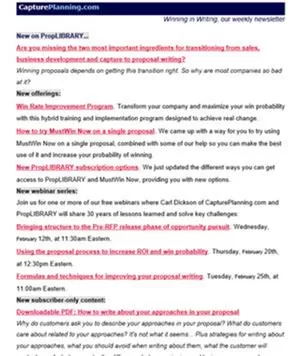 We publish our newsletter weekly. You will receive the next one when it comes out. Please make sure to put it on your email white list or move it to your priority tab so that your email software doesn't hide it from you. Here is the link for downloading your copy of our eBook: Turning Your Proposals Into a Competitive Advantage Here are some other useful links: Beginners should start here Why your good proposal is going to lose What is the simplest, eas
- 0 comments
- 8,266 views
-
 I’m passing some of my time in isolation talking to people free of charge and assessing how to improve their pursuit and capture processes in the new world we find ourselves in. We can talk about reengineering how you go about winning business and come out of this better than you ever were before. Want to know what Carl would recommend? Just ask me. Click here to send me a question Or use the widget below to grab any open spot on my calendar before they’re filled and I’ll
- 0 comments
- 1,322 views
-
 You’ve got to start somewhere. So companies often start by responding to as many RFPs as possible, hoping to win a few to get the company established. Once they are established, they can reassess and start doing things strategically. When should they reassess and begin to change? That day is now. How do I know? Because your win rate is so low that you can double your revenue by increasing your win rate without chasing any more leads. Your win rate is low because you’re bidding without a com
- 0 comments
- 1,532 views
-
Pursuit and capture set the stage for the proposal. But while the proposal process gets a lot of attention, pursuit and capture are often left to someone to just figure out. The roles are commonly referred to as sales, business development, or capture. Without much process or at least guidance, the entire pre-RFP phase can devolve into an exercise in lead tracking instead of lead pursuit and capture. This table implies what you should accomplish during pursuit and capture. You can build a p
- 0 comments
- 248 views
-
 Most proposals are won or lost before they begin. Either you go into the proposal with an information advantage, or you are trying to fake your way through the proposal without one. Even though this is true, most companies don't have a mature process for pursuing a lead before the proposal starts. Their process amounts to: Hire a good salesperson, whatever that means, to dig up some information. Create the illusion of process by having bid/no bid reviews. As a company matures,
- 0 comments
- 4,160 views
-
 Most companies think that the best way to win on price is to figure out what price your competitors will bid and try to come in below that. But that’s just believing the lie. It also doesn't point you towards any viable bid strategies other than lowering costs and hoping the customer lets you get away with it without destroying your past performance record. It sets you up to bid less for the same amount of work, and either make little or no profit, or to actually lose money. When it’s up to
- 0 comments
- 8,683 views
-
 Our instincts betray us. Playing it safe will lower your chances of winning. In our regular life, sometimes playing it safe is necessary for continued survival. But in order to have a superior, winning proposal, it must first be different. Different in a way that no one else can match. You don’t get there playing it safe. Anticipation and research. What professionals do is try to anticipate the issues, conduct research, and start the proposal already informed with your mitigations and s
- 0 comments
- 1,878 views
-
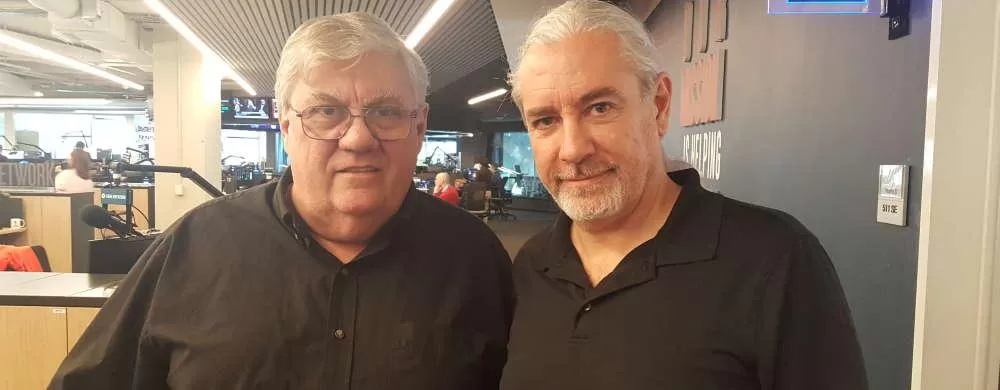 Mark Amtower and I go back over a decade. That's Mark on the left and me on the right above. We have over 530 mutual connections on LinkedIn. I've been interviewed by Mark for his radio show at least seven times. But on the March 16th show we really got into it and explored the lies that contractors tell in their proposals as well as the huge insights about the proposal process I've had from building MustWin Now. Here are all the times I've been interviewed by Mark for Federal News Network
- 0 comments
- 1,073 views
-
This module is a chance to finalize the work from the previous exercises and prepare them for implementation. The course materials for this module provide an opportunity to reflect on what you have created so far, look at it from several perspectives, and ensure it is ready for real-world use. During this module you should review and make any improvements needed to the process items you have created. You should also apply final formatting and production to them (logos, headers, footers
- 0 comments
- 453 views
-
This module takes the approach to building lists of questions from the last module and applies it proposals that start at RFP release. The difference is subtle but important. Proposal inputs forms must ask questions that can be answered immediately and probably without being able to conduct much research. They are about discovering what you already know and articulating it in a way that proposal writers can use. They can have a big impact. Having some information to work with is a lot bette
- 0 comments
- 631 views
-
 Responding to RFP requirements is not simply a matter of checking off the fulfillment of each specification. Understanding the reasons why the customer asks for those requirements can give you insight into what really concerns them. Writing to what really concerns them can increase your win probability. Includes strategies for writing about fulfilling the RFP requirements, what might impact the customer's evaluation, and what can make the difference between winning and losing your proposal.
- 0 comments
- 1,842 views