Articles
-
 There is a place for short-term thinking. You've got to start somewhere. But there are also risks. And it's easy to become sidetracked along the way. This creates an opportunity to beat your competitors by continuing to evolve when they get stuck. Short-term proposal thinking The bridge to long-term proposal thinking is usually your business development and proposal process. Companies seek to formalize their process when they want to start doing things consistently better in the futu
- 0 comments
- 6,608 views
-
 The easiest corporate strategy for growth is to bid everything. Proposal professionals hate this strategy because it results in a low win rate that they expect to get blamed for. It also increases their workload for little gain. But the undeniable fact is that you can win business by bidding opportunistically. That’s what makes it so tempting. The result is a certain… tension… Whether you should bid opportunistically or strategically is a simple return on investment calculation. Add up y
- 0 comments
- 11,208 views
-
The keywords that some use when searching for opportunities produce a lot more false hits that the keywords that other companies use. The suggestions below can help you reduce the number of pages of irrelevant opportunities you have to wade through to get to the good ones. But even when you do have to manually read them to determine whether they are relevant, if you have clarity about what leads you don’t want, you can greatly accelerate things. You can establish a process based on reading
- 0 comments
- 245 views
-
When you've been asked to help write themes and you're stuck, decide which of these types bests matches what you need and then formulate some themes based on that type. Strengths and advantages. This is particularly useful when the evaluation criteria are based on strengths and weaknesses. Pointing out your strengths and competitive advantages is good to do, but only if they pass the “So what?” test. Being merely compliant with the RFP is not a strength. Your strengths and advantages onl
- 0 comments
- 190 views
-
The reasons why tables help reduce the page count are: RFPs usually allow for a smaller font size in tables The text that goes in a table can be succinct, use fewer words, and not to be complete sentences Table text can be repetitive, but tables also help you eliminate the repetitive parts Tables enable you to show relationships without explaining them Tables can show required data without having to talk about it. Just don't fill your tables with whitespace
- 0 comments
- 157 views
-
 A dozen versions of the same paragraph, with more than 50 things done wrong and how to correct them.
- 0 comments
- 1,097 views
-
Don't look at filling your pipeline as one big monumental task. Divide and conquer. Do this based on defining categories for your leads and setting targets. People often look for “a” source of leads, when they should be looking for all of the potential sources of leads. But what percent of your leads should come from each? This varies a great deal, company by company. What you don’t want to do is chase them all with the results being random, because then your company will grow like a weed.
- 0 comments
- 152 views
-
 What’s the point of it all? What does the customer want to hear from you? What do they need to complete their paperwork? What makes you their best alternative? These are the kinds of questions you should be asking as you prepare to write an Executive Summary for a proposal. To answer them, you need these four things: A winning solution or offering design. You can’t articulate why the customer should care about what you are offering, if you yourself don’t know what you are offering. You n
- 0 comments
- 2,762 views
-
 The things you need to communicate, your priorities, and the best sequence for presenting them should change from proposal to proposal, based on what it will take to win. If you always write your Executive Summary in the same sequence with the same topics in the same order, you should reexamine your priorities. Start with two simple questions: What does the customer want to see? What do you need to say? What you want to say should match what the customer wants to see. Usua
- 0 comments
- 2,101 views
-
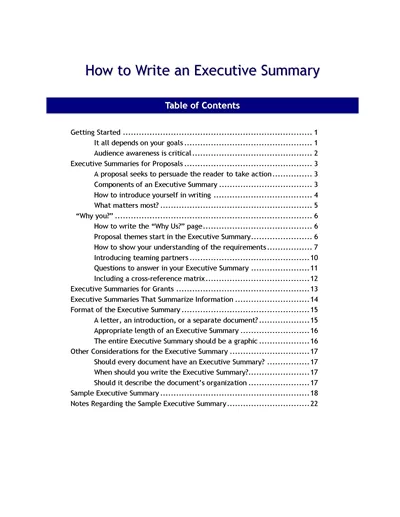 This is the electronic version of the tutorial we publish. It addresses: It also includes and a sample to show how the pieces come together. Writing different types of Executive Summaries Why an Executive Summary might not actually contain a summary How to introduce yourself in writing Multiple strategies for preparing to write an Executive Summary How to incorporate your win strategies into writing the Executive Summary Advice for how to format your E
- 0 comments
- 1,291 views
-
- 0 comments
- 239 views
-
what matters to the customer.
- 0 comments
- 359 views
-
Often preparing the pricing is that last thing people do when working on a proposal. This is especially true with proposals for services where people have to figure out what their offering is going to be before they can price it. However, a good argument can be made that proposal pricing should be done first. In between those two sits the basis of estimate (BOE). A BOE is a combination of the data and formulas you’ll use to calculate an estimate, such as the price for doing something. A
- 0 comments
- 247 views
-
 Information gathered pre-RFP must be assessed and become part of proposal content planning for it to reliable find its way into the proposal document. Creating the items described in this exercise can help you streamline and integrate these efforts.
- 0 comments
- 418 views
-
 In between collecting proposal input and the outline/compliance matrix is the kickoff meeting. The kickoff meeting is an opportunity to integrate efforts and get everyone on the same page.
- 0 comments
- 332 views
-
 Proposal development should not be treated as an expense to be minimized. It is an investment as part of the cost of sales. When you compare what an increase in win rate does to your revenue, you find that the investment generates a positive return. Decreasing the investment leads to a lower win rate, and what that does to your revenue is create a death spiral. The trick is to lower proposal development costs without lowering your win rate. A winning proposal is one that is based on what yo
- 0 comments
- 5,122 views
-
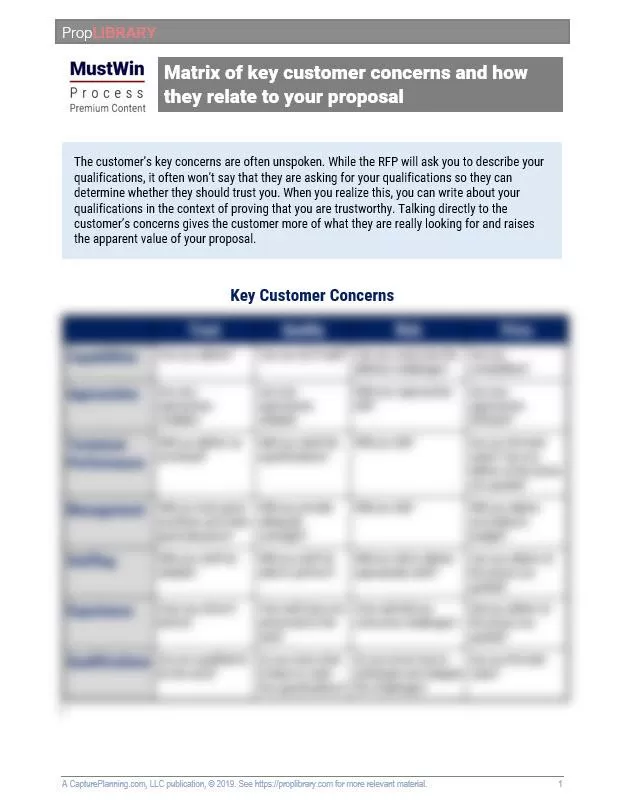 The customer?s key concerns are often unspoken. While the RFP will ask you to describe your qualifications, it often won?t say that they are asking for your qualifications so they can determine whether they should trust you. When you realize this, you can write about your qualifications in the context of proving that you are trustworthy. Talking directly to the customer?s concerns gives the customer more of what they are really looking for and raises the apparent value of your proposal.
- 0 comments
- 1,422 views
-
 This is an example of a solution that we prepared for someone else. The solution that we prepare for you will be based on your particular needs. However, it’s a good way for you to get an idea of how we work and a great way to start a conversation about how your needs are similar or different. The Customer’s Circumstances. A company with international offices contacted us about proposal training for 500-600 people. They weren’t sure what to do because it just wasn’t economical to send an in
- 0 comments
- 2,445 views
-
 This is an example of a solution that we prepared for someone else. The solution that we prepare for you will be based on your particular needs. However, it’s a good way for you to get an idea of how we work and a great way to start a conversation about how your needs are similar or different. The Customer’s Circumstances. A company wanted training in proposal writing provided at their site. They were potentially interested in other services, but wanted to start off with the training.
- 0 comments
- 2,826 views
-
 This is an example of a solution that we prepared for someone else. The solution that we prepare for you will be based on your particular needs. However, it’s a good way for you to get an idea of how we work and a great way to start a conversation about how your needs are similar or different. The Customer’s Circumstances. A company with multiple business lines (B2B and B2G) wanted to improve the quality of their proposal writing and accelerate their proposals. Their initial plan was to imp
- 0 comments
- 3,441 views