Articles
-
 Themes come from many sources, all of which depend on having the right information. These include what you know about: The opportunity The customer The competitive environment Yourself and your offering The RFP The following table can help point you in the right direction to identify themes for your proposal: Source Consider Topics Like: Opportunity Intelligence What are thei
- 0 comments
- 223 views
-
 Attributes of good themes: Does it reflect a result or benefit to the customer instead of an attribute of your offering? Does it matter? Is it believable? Does it address what the customer wants? Does it discriminate you from your competition? Does it reflect the conclusion you want the reader to reach? Can it be scored? Bad Themes: Do not pass the “So what?” test Matter to the writer, but not to the evaluator Are impossi
- 0 comments
- 202 views
-
 Most proposal theme statements are either: Grandiose statements that sound like bragging and are completely unsubstantiated. Like being the largest, best-industry leader ever. Or: Bland, boring statements that the customer should pick the company submitting the proposal without explaining why. So much blah, blah, blah. Both of them are a result of trying to describe yourself in favorable terms or how you want to be seen. But they don’t provide any value to the customer or h
- 0 comments
- 202 views
-
 Win strategies and themes provide the customer with a reason to select you. If you do not communicate them to your writers, the proposal will not be written to substantiate them. You should distribute a copy of your win strategies and themes that you want your writers to substantiate. You can use this form to help identify them. You should prepare a list of theme statements before the RFP is released so that your plans reflect your win strategies. Once
- 0 comments
- 154 views
-
 Proposal themes are how you implement your win strategies in writing. They articulate the reasons why the evaluation should select you. In your final proposal, themes can take many forms. They can be headings and subheadings, go in text boxes, be part of the text, or be captions for graphics. In a sense, the entire proposal can be thought of as one big theme statement. How you present them is determined by the design of your proposal template. In order to be effective, your theme
- 0 comments
- 195 views
-
 Kickoff meetings can help get everyone on the same page, with the same set of expectations The Proposal Manager should determine the schedule, agenda, and goals for the kickoff meeting. The Proposal Manager should coordinate with the Capture Manager, Executive Sponsor, and other key stakeholders prior to the meeting, and then lead the meeting when it is time. Kickoff meetings are held to announce the start of the proposal. At the kickoff meeting you may:
- 0 comments
- 321 views
-
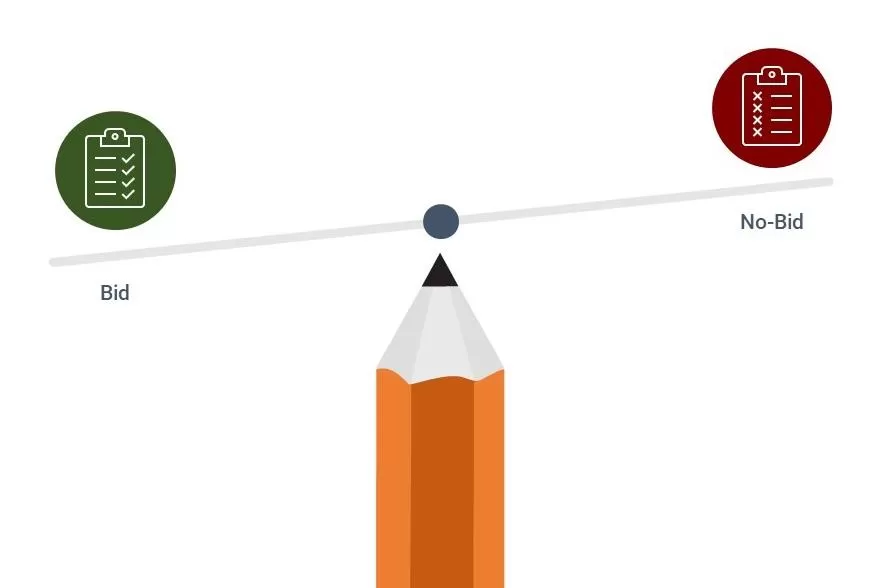 You should make a conscious decision whether a pursuit is worth investing in Think about the price of continued investment and not what you have already spent. Discipline is required to “no bid” opportunities that are a bad match, not worth pursuing, or simply questionable. The burden should be on justifying pursuit of the opportunity, and not on cancelling it. Deciding whether to bid an opportunity is not just a matter of guessing how much mone
- 0 comments
- 899 views
-
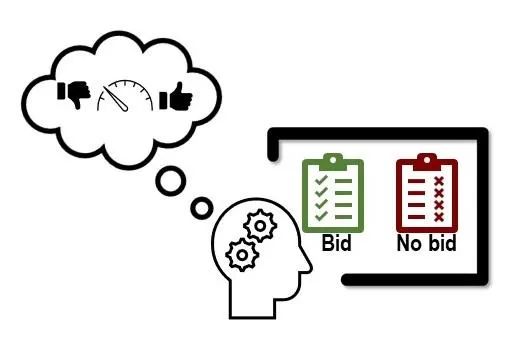 If we had to pick one thing to change that would have the most impact on an organization’s ability to win, it would be how they approach bid/no bid decisions. If you think of them as just being about deciding whether to bid, you’re missing a tremendous opportunity, because they can have a much greater impact on how you bid, than just on if you bid. Do you know what percentage of bids you drop at each stage or do you never drop anything? Do the things you bid reinforce your strateg
- 0 comments
- 241 views
-
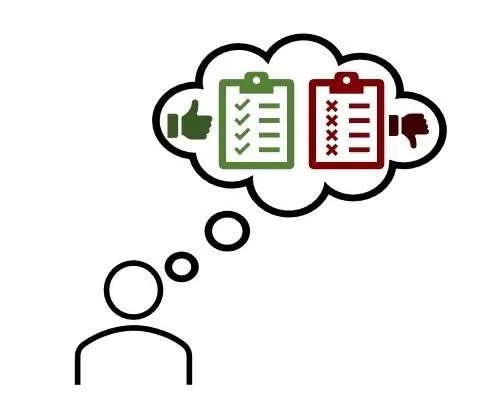 Making effective bid decisions: Every pursuit progress review should be considered a “Bid/No Bid review.” Bid decisions should be about return on investment and not gambling. At each step, the decision should be whether to commit the resources required to get to the next decision point. You can't accurate predict your chances of winning, but you can assess whether you have met the conditions required to bid with a competitive advantage.
- 0 comments
- 366 views
-
 If you complete all of your opportunity readiness reviews but the RFP does not come out on time, you should put a monitoring program into place. Your plans are based on the earliest anticipated RFP release. But what if it gets delayed or comes out later than that? The Business Developer and Capture Manager should take advantage of that time. The Executive Sponsor should set up a schedule (weekly, bi-weekly, monthly?) to review the status. Suggestions for what to monitor while you are wai
- 0 comments
- 163 views
-
 The MustWin Process will not break if you start late. In fact, it tells you exactly what you need to do to get caught up. Regardless of how much time is available, you still need to identify, assess, and achieve what it will take to win. Whether you can achieve it depends on how much time is left after you've identified and assessed it. The MustWin Process accelerates these steps by providing the questions you need to answer and what you need to do. The rea
- 0 comments
- 203 views
-
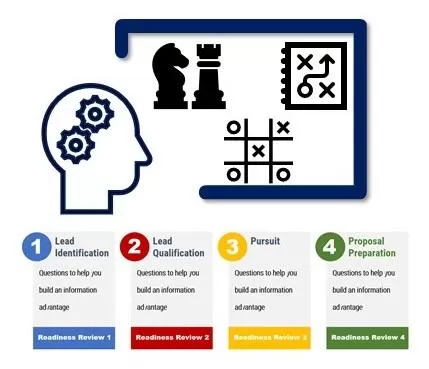 A Strategic Plan, in addition to identifying markets and targets, also defines the high-level positioning for your company. Unless it gets ignored. Most proposals are conducted without any consideration of the strategic plan, and all of the positioning elements like win strategies and themes are re-invented in isolation. Sometimes people who have read the strategic plan try to keep it in mind. The list of questions, goals, and actions items that the Readiness Review methodology uses gives
- 0 comments
- 163 views
-
 Readiness Reviews are a methodology we invented to ensure that the pre-RFP process delivers the information you need to write the winning proposal. They do this by making better use of the time available (whatever that ends up being) between when you identify a lead and when the RFP will come out. Readiness Reviews prompt people with what to do and provide a means to track progress and even measure effectiveness. They make the pre-RFP pursuit less of some kind of mysterious art and more of a sci
- 0 comments
- 303 views
-
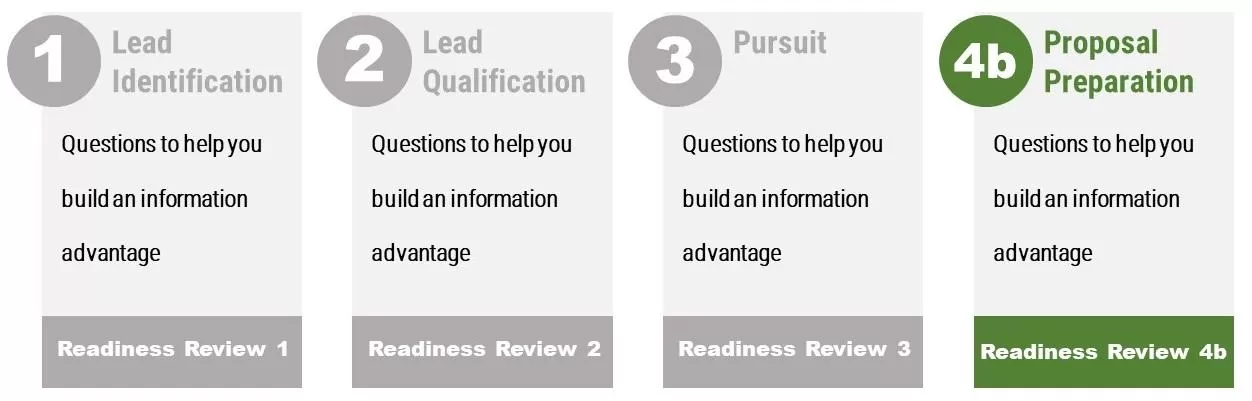 The Capture Manager is responsible for assessing the intelligence collected by the Business Development Manager and turning into the win strategies necessary to win the opportunity. The last Readiness Review is conducted in two parts, one completed by the Business Development Manager and the assessment completed by the Capture Manager. The completion of the last Readiness Review also completes the hand-off from the Business Development Manager having the lead role for the pursuit, and the Captur
- 0 comments
- 327 views
-
 The following scoring sheet summarizes the questions to be answered, action items to be accomplished, and goals to be achieved for this review. Each one should be assessed to determine if the pursuit is on track to be ready to win at RFP release. Question, Action Item, or Goal Guidance Score Opportunity Intel Do you know the final scope/customer requirements? Has anything changed? Time is running out to take corrective acti
- 0 comments
- 356 views
-
 The following scoring sheet summarizes the questions to be answered, action items to be accomplished, and goals to be achieved for this review. Each one should be assessed to determine if the pursuit is on track to be ready to win at RFP release. Question, Action Item, or Goal Guidance Score Opportunity Intel Describe the scope/customer requirements in detail. What do you anticipate will be included or excluded? Include eve
- 0 comments
- 449 views
-
 The following scoring sheet summarizes the questions to be answered, action items to be accomplished, and goals to be achieved for this review. Each one should be assessed to determine if the pursuit is on track to be ready to win at RFP release. Question, Action Item, or Goal Guidance Score Opportunity Intel Are you sure about the scope/customer requirements? The scope can change as the customer looks for consensus, feasib
- 0 comments
- 265 views
-
 The following scoring sheet summarizes the questions to be answered, action items to be accomplished, and goals to be achieved for this review. Each one should be assessed to determine if the pursuit is on track to be ready to win at RFP release. Question, Action Item, or Goal Guidance Score Opportunity Intel What is the scope of the opportunity? What does the customer require? Include everything necessary to estimate the
- 0 comments
- 411 views
-
 Readiness Reviews are where the measuring of progress takes place. Without them, progress is uncertain, and you will probably find yourself unprepared at RFP release. The Executive Sponsor is responsible for performing the Readiness Reviews. The goal of the Readiness Reviews is to track progress towards being ready for RFP release. In performing the reviews, you should do more than simply assess any deficiencies. Wherever possible, you should identify the
- 0 comments
- 174 views
-
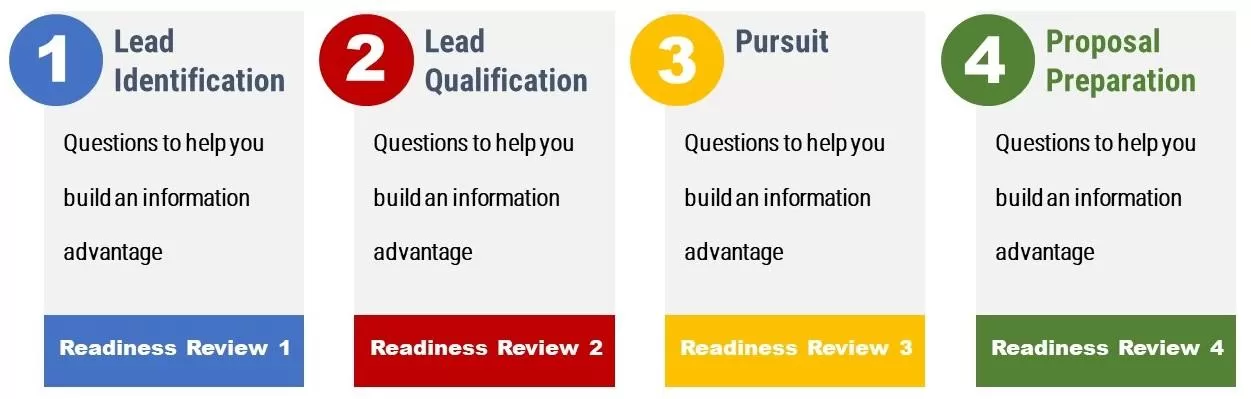 Within the CapturePlanning.com MustWin Process we measure progress and quality against what it will take to win. During the critical pre-RFP phase of the pursuit, we use Readiness Reviews to ensure measurable progress towards discovering what it will take to win. Readiness Reviews bring structure to the pre-RFP phase of pursuit and help ensure that you arrive at RFP release and begin the proposal prepared to win. Each Readiness Review has specific questions, goals, and action items that mu
- 0 comments
- 7,986 views