Articles
-
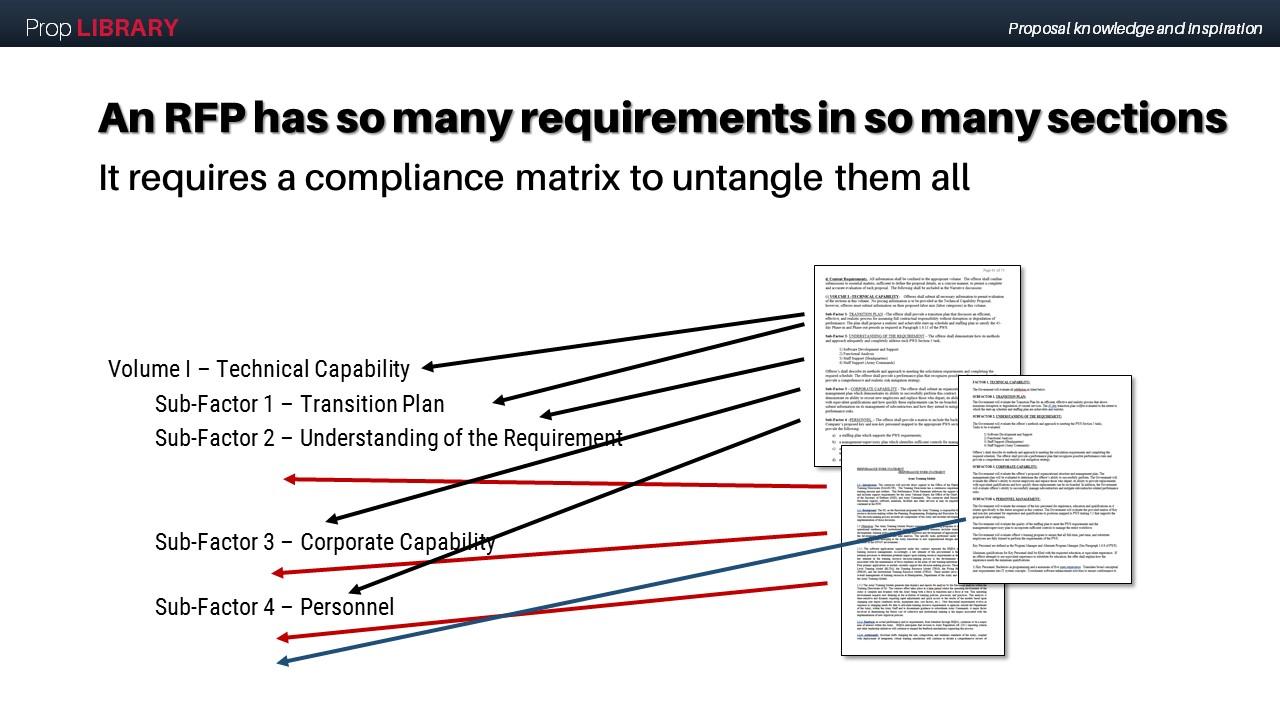 Creating a compliance matrix sounds complicated in text. View this slide show to see how it works.
- 0 comments
- 18 views
-
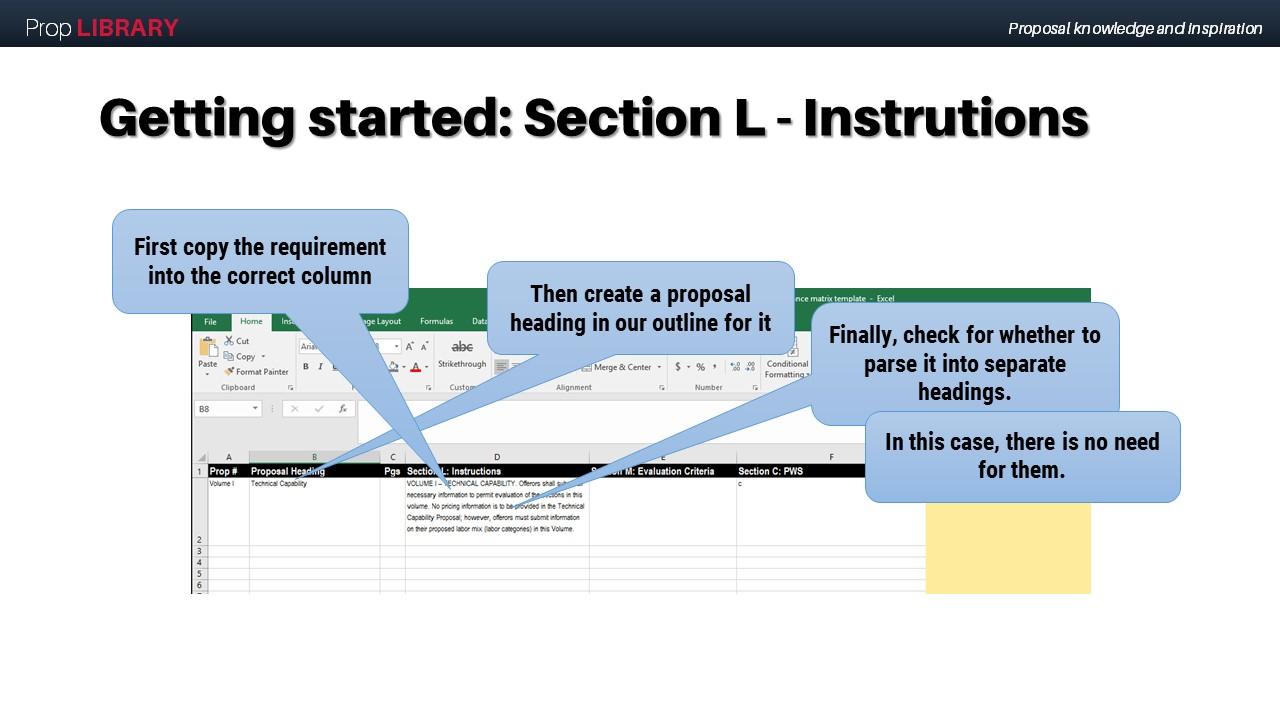 Cross-reference matrix creation sounds complicated in text. View this slide show to see how it works.
- 0 comments
- 14 views
-
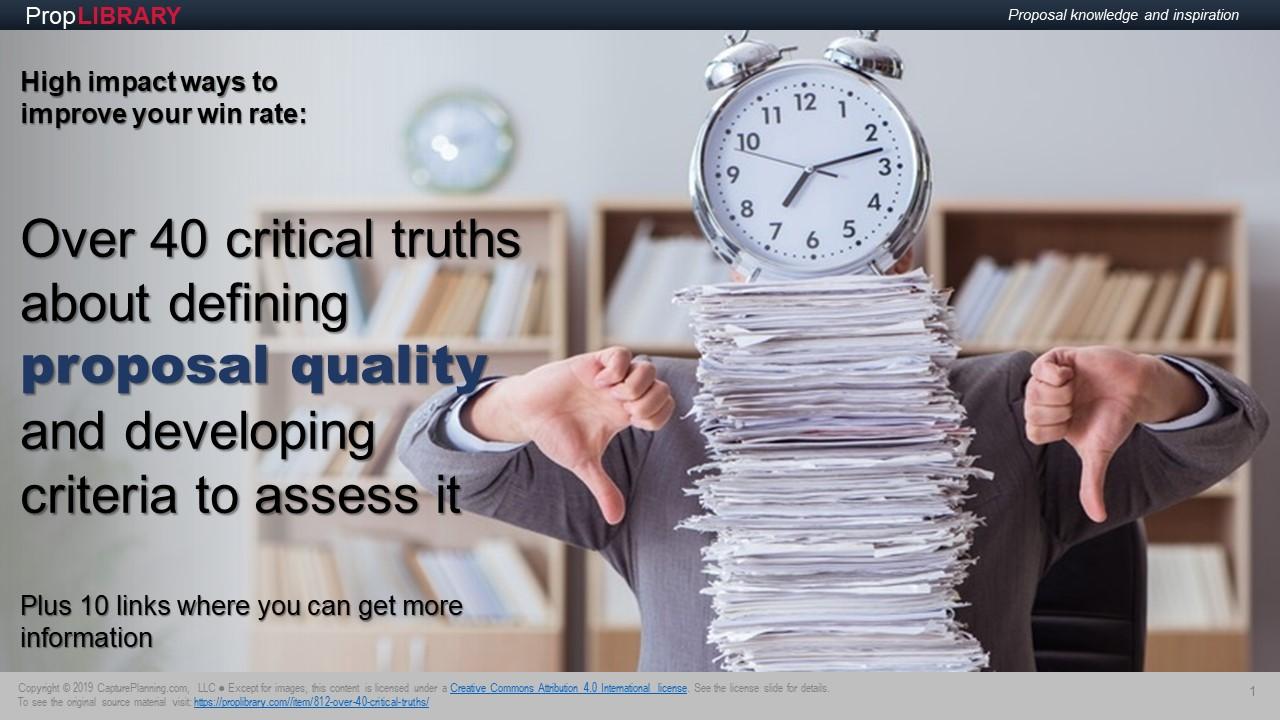 A presentation Carl Dickson, founder of PropLIBRARY gave on the topic of What defines proposal quality and how can you develop quality criteria to assess it.
- 0 comments
- 15 views
-
monthly_2025_09/HowchangestoPropLIBRARYwillcreateopportunitiesforconsultants.mp4.19cf4908cb97009392820465cd693750.mp4
- 0 comments
- 1,543 views
-
 Great proposal writers often have to write about things they don't know anything about. How do they do it? Instead of thinking about what they can say, they: Start by figuring out what needs to be said Break down what the customer has asked about Consider what the customer needs to hear for each one Address how they prove their claims Finish with what would show the most value These are just some of what they need to figure out, and not the seque
- 0 comments
- 4,068 views
-
monthly_2025_09/Recording-HowPropLIBRARYisadaptingtoanAIworld.mp4.ece5e53d998ec6cd869a988f62fc2b5f.mp4
- 0 comments
- 2,287 views
-
 monthly_2025_08/Video1917372039b.mp4.b43e4a0658c81b4cb6400a0fc6f6d2c1.mp4
- 0 comments
- 1,578 views
-
 PropLIBRARY is evolving. 24 years ago, it started as an online content resource with practical information about proposal management, capture management, and business development to help people win proposals. PropLIBRARY has evolved many times to expand the ways it helps people win. For example, we added the MustWin Process as an off-the-shelf, customizable starting point. Then we added online training to help people succeed as they implemented the process. Then we automated the process, but bui
- 0 comments
- 1,823 views
-
 Instead of looking at your proposal process as a series of steps, try looking at the problems you need to solve for your process to be effective. You'll encounter problems, big and small, on every proposal you do. But some of the problems are more fundamental than others, and have a bigger impact on your win probability. Solving these problems will make your process far more effective. The bid/no bid problem. How do you avoid wasting time on proposals that aren't worth bidding? This is n
- 0 comments
- 5,914 views
-
 Everybody thinks they are trustworthy. And yet obviously, some of us are not. Even if you brand yourself as a “trustworthy partner” or a “trustworthy advisor” in all your materials, the first thing that half of the people who see or hear that are going to say to themselves is “how do I know that's true?” All those people have doubt and you just made them question whether they can trust you. You can't simply claim to be trustworthy. When we meet in person, trust has to be earned. But th
- 0 comments
- 4,777 views
-
 Proposal Review Need #1 I need people who show up having already read the RFP. It sounds like a small thing, but proposal reviews often rely on single staff with many things competing for their attention. Preparing ahead of time doesn't always happen. The reason this is important is that if you don't already understand the instructions, evaluation criteria, and contract, pricing, and performance requirements before you start to review the text, the review is more likely to be based on vague
- 0 comments
- 3,031 views
-
 Stress is unhealthy for your win rate — never mind it also being unhealthy for the people working on proposals. If you want to maximize your win rate, you can't ignore the things in your organization and environment that make proposals more stressful than they need to be. The benefit to your company's win rate is what should make reducing stress a corporate priority. However, you can't just reduce stress by telling everyone to calm down. Have you ever noticed that telling people to calm down h
- 0 comments
- 3,277 views
-
 If you are treating your pink team review as a progress review to see how the proposal writing is going, then you are doing them wrong. And you are setting yourself up for a bad experience at the red team review. You are missing a vital opportunity and will suffer a lower win probability than a company that has a better definition for what a pink team review should be. A pink team review should be a blueprint review prior to the construction of the proposal. The blueprint for a proposal i
- 0 comments
- 2,569 views
-
 A thesis is tremendously helpful for proposal writing because it gives you something to prove. A thesis is the central claim in a paper. When you try to write a thesis for a proposal, you'll probably struggle and that's a good thing. If you want to win, you should be putting some effort into figuring out what to write before you just throw words at the customer. The difference between a proposal thesis and a theme is that themes more easily degrade. Theme statements intended to link your p
- 0 comments
- 1,241 views
-
 There are two reasons why your company struggles with conflicting priorities during proposals: Everything is a tradeoff and the tradeoffs impact people differently. Decision makers struggle with the same tradeoffs and so have not brought clarity to everyone else. Here's how this causes a reduction in your win rate. People with experience and knowledge are always in demand within a company, especially when it comes to finding people to contribute to proposals. There are many
- 0 comments
- 2,547 views
-
 When it comes to proposals, there is a lot more to honesty than just knowing where the line is that turns stretching the truth into lying. In fact, you'll encounter far more issues related to honesty everywhere else! Honesty in assessing win probability. How many times have you heard people tell the lie, “We should bid this because we can do the work and we could win?” How many reports incentivize showing a high win probability? How often is a pWin percentage given with a straight fac
- 0 comments
- 3,670 views
-
 Bids for commodities simply require quotes. Bids for complex services and solutions require proposals. Every proposal is developed under different circumstances. To maximize your win rate you must become superior at figuring out how to turn those circumstances into a competitive advantage every time. Companies that try to create an assembly line for their proposals end up creating a machine that loses in volume. Don't define your proposal process by making it based on rules. Rules will bre
- 0 comments
- 4,670 views
-
 Proposal work requires people to use judgment and not just blindly follow procedures. Wherever possible, it is better to define the proposal process as a series of questions instead of a series of steps. The beauty of using questions is that: You can easily tailor them for your corporate culture and issues. A list of questions is also easy to change over time. This makes them a great way to ease process in and to continuously raise the bar by periodically changing the questions.
- 0 comments
- 1,365 views
-
 Proposal reviews are notoriously difficult to optimize. Part of the problem is that no matter how mature your process, it's difficult to keep your proposal reviewers in sync with it. The nature of the problem I've found that at a lot of companies, it can be difficult just getting your reviewers to show up prepared. When reviewers show up without having read the RFP, the results of their review will be more subjective and less relevant to increasing win probability. Reviewers tend t
- 0 comments
- 4,043 views
-
 That's not a typo. I said how to tell if your win rate is too high. I obsess over improving win rates. I do everything possible to increase them. And yes, it is possible for them to get too high. The highest sustained win rate I've seen a contractor have was 87%. It was a company that had a huge software advantage in a tiny niche with repeat customers. And they stayed in it. They had discipline. They did not bid things at a disadvantage. Their win rate was too high. It limited their gr
- 0 comments
- 3,676 views