
Carl Dickson
Administrators
-
Joined
-
Last visited
Everything posted by Carl Dickson
-
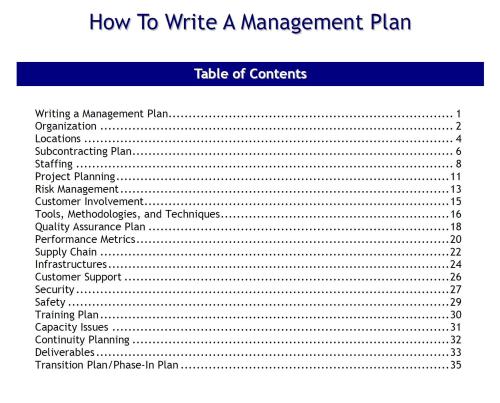 Before we wrote the MustWin Process Workbook, we wrote a series of tutorials that included How to Write a Management PlanFree
 -
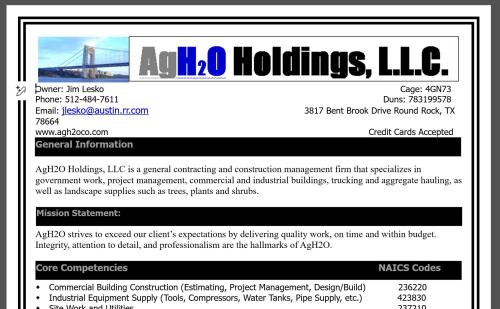 Capabilities Statement for AgH20Free
 -
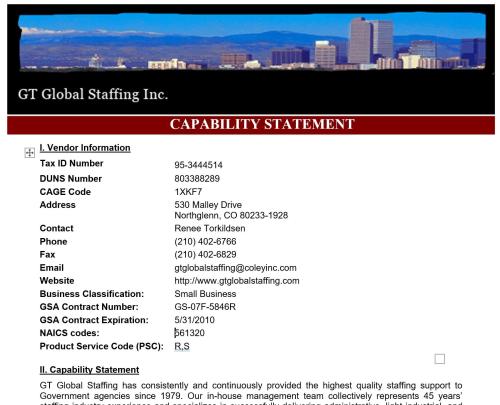 Capability statement for GT Global StaffingFree
 -
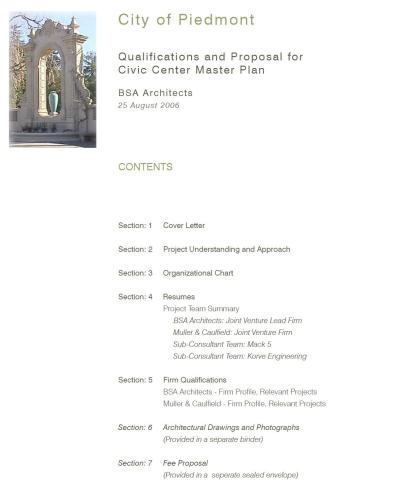 Sample Proposals for the City of Piedmont Qualifications and Proposal for Civic Center Master PlanFree
 -
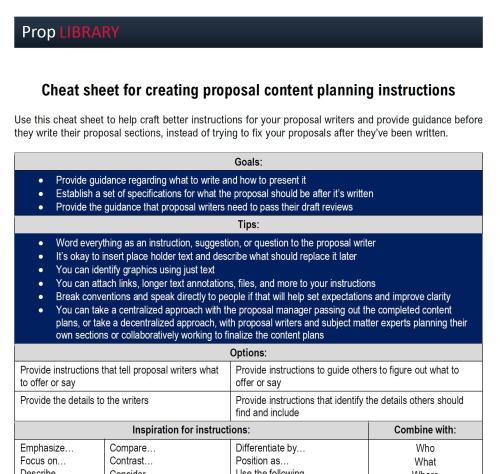 For use during Proposal Content Planning. Provides inspiration for what to include and how to articulate it to guide proposal writers to create the desired proposal.Free
 -
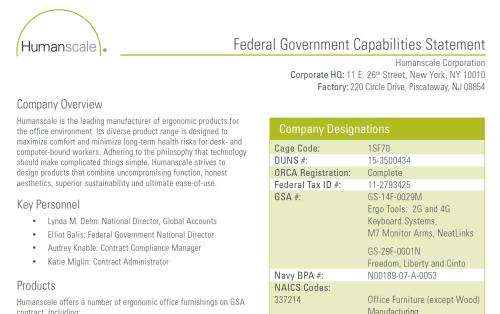 Sample of a Capability StatementFree
 -
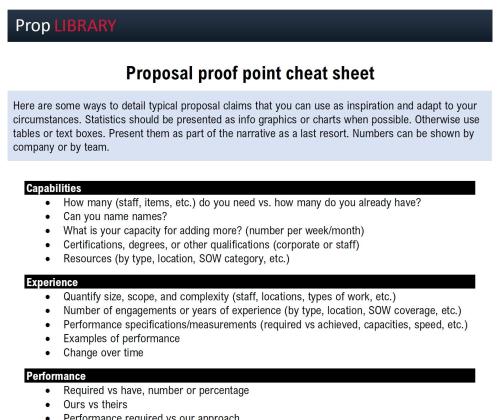 Proof points are vital for winning proposals. But asking people to "insert some proof points" often falls flat. This cheat sheet can help inspire people to supply relevant proof points.Free
 -
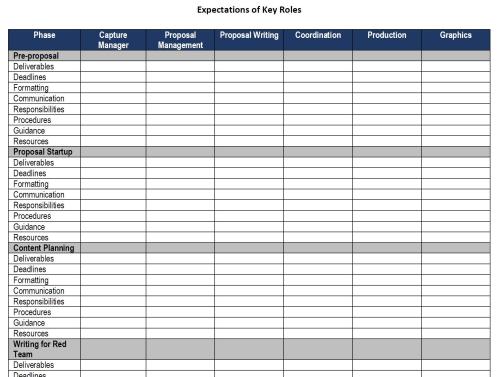 This matrix enables you to quick document what is expect of each role supporting a proposal through each phase of proposal development. When you view across the roles you can see how the team works together to accomplish each phase.Free
 -
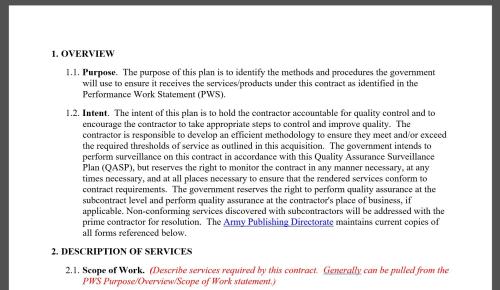 These templates are to assist contractors in completing their Quality Assurance Surveillance Plan (QASP).Free
 -
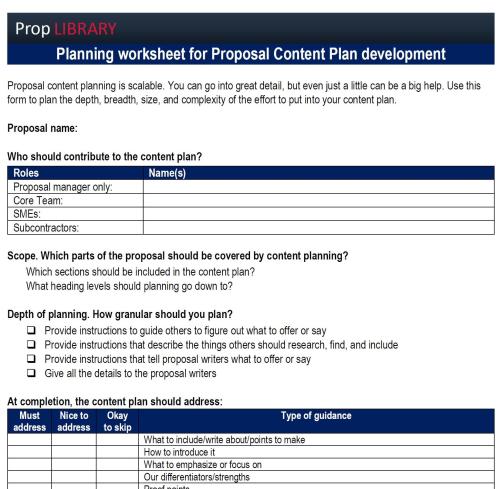 What should you put in your content plans? How should you articulate the things you include? Who will be involved. For individuals, this worksheet provides inspiration. For groups, it helps set expectations.Free
 -
 Online training with multimedia, exercises, and quizzes
 -
 1 of 54 pages of best practice guidance. All categorized so you can find what you need in a given moment.
 -
 A presentation given by Carl Dickson, founder of PropLIBRARY, on the topic of defining your proposal quality criteria.Free
 -
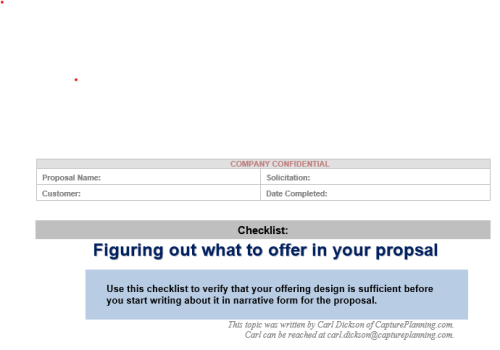 A simple checklist to help you figure out what you offer in your proposals.Free
 -
A presentation Carl Dickson, founder of PropLIBRARY gave on the topic of What defines proposal quality and how can you develop quality criteria to assess it.
-
monthly_2025_09/HowchangestoPropLIBRARYwillcreateopportunitiesforconsultants.mp4.19cf4908cb97009392820465cd693750.mp4
-
monthly_2025_09/Recording-HowPropLIBRARYisadaptingtoanAIworld.mp4.ece5e53d998ec6cd869a988f62fc2b5f.mp4
-
If you depend on your website and pay attention to the traffic you get from the search engines, you've probably noticed a decline over the last couple of years. A Pew Research Center report found those who get the AI summaries in their searches visited websites in the search results half as often. And in May, Google started showing these to everyone by default, even if you have not opted in. There have been many other, similar reports. This trend will continue and has incredible implications for the future of everyone who does business. As if that wasn't enough, AIs play by different rules when it comes to intellectual property. And all the benefits of AI could go away if we forced them to play by the rules the way they've been traditionally interpreted. Every business that involves teaching, explaining, and informing based on intellectual property is going to have to transform or wither and die. That includes PropLIBRARY, but we've worked out how to do that. I've spent a lot of time thinking about this, how to not only address the challenges, but to turn them into opportunities for growth. And now I'm ready to talk about not only what we're going to do, but why and how it impacts everybody else. Next week I'll be announcing dates for a series of webinars to discuss it all. The massive changes to the way online business works and the way our society handles intellectual property impact the future in ways that are not obvious. Everyone obsesses over whether AI will change or destroy jobs. What's easy to overlook is that AI is going to completely redefine how we do business. It will change many of the principles our society takes for granted, like those related to intellectual property. It will change how businesses get discovered, how they interact with their customers, what their customers need from businesses, and the exchange between customers and businesses. That pretty much covers everything business. Everything is going to change. On the scale that AI is being implemented as we speak, it will change how the entire economy functions. The days of being able to start a business with a website and grow it over time may vanish. The reason is that search engines as we've known them for more than 20 years no longer exist. Every search engine is moving as fast as they can to become a destination instead of a connector. They are not incentivized to connect their users to the sources they pillaged to create the answers they've given. What are they incentivized to do? Connect people to advertisers. In the future you'll have to pay for every click you get. This will transform how you go about marketing, as well as everything else about websites. But it will also transform everything about teaching, explaining, and informing. And everything else business. So when I say PropLIBRARY is transforming, I mean we're doing paradigm-shifting changes in everything from business model, approach to marketing, product development, and how we plan to interact with customers and business partners. And to make our plan work we have to share exactly what we're going to do. Which, for us is easy, because our business was basically built on over-sharing from the beginning. Stay tuned. Next week we'll announce dates and times for the webinars and how you can submit your questions in advance so we can make sure we address them.
-
PropLIBRARY is evolving. 24 years ago, it started as an online content resource with practical information about proposal management, capture management, and business development to help people win proposals. PropLIBRARY has evolved many times to expand the ways it helps people win. For example, we added the MustWin Process as an off-the-shelf, customizable starting point. Then we added online training to help people succeed as they implemented the process. Then we automated the process, but built in extensive guidance. Over all that time, PropLIBRARY became a resource that blurs the line between training and performance. Now it's becoming something different. It's becoming an ecosystem. Over the next few weeks we'll be revealing more about the changes that are coming. We're even going to have a series of webinars to discuss them and not only to give you a chance to ask questions, but to engage with us on the direction we're heading. An ecosystem results from interconnected, interdependent contributions that add up to something greater than the sum of its parts. To become an ecosystem we have to grow larger than ourselves. We're doing this by focusing on enabling people to work together and all the things they need to win proposals. We're moving from an “us to you” publishing model to an “everyone to everyone” networking and engagement model. We're opening up our platform to other contributors and turning into a community. But that doesn't really capture what we're doing. We're enabling our subscribers to get involved and we're sharing the spotlight. We're enabling employees, consultants, and others to work together and improve their ability to win proposals in more ways than we can provide on our own. We're doing this by using PropLIBRARY as a hub to facilitate how people network, discover, and inform each other. Our audience is huge and it is full of experts. PropLIBRARY users include: Employees of companies who want to learn and improve their win rate, and are open to new perspectives on the issues they face Consultants and services providers who are lifetime learners, and love opportunities to share and demonstrate their knowledge and skills There are challenges, but we've got them covered The consultants on our site and employees of companies in the B2B space may want to sell to the employees of companies in the B2G space. The trick with opening up like this is to provide the right balance between practitioners and sellers. But I've been running extremely large groups on LinkedIn for 20 years and understand how that works. We're not even going to have advertising. As you have no doubt seen, sites that go down that road become all advertising all the time. What they really become is a platform for selling to their users and their customers are really the advertisers. What do you think LinkedIn is really designed to be? What we want instead is a community based on discussions, finding resources, networking, and a constant focus on best practices. Sellers will have to learn how to talk about their role in supporting best practices instead of... selling. The goal is to enable both parts of our audience to engage like they would at a networking or association event. None of the existing social platforms out there lend themselves to having ongoing conversations. Even LinkedIn. Most platforms are designed for reactions and encourage people to shout their retort and move on. It's hard to get a question answered on LinkedIn because it's lost in the endless stream of ads people call posts on LinkedIn. Most groups are just ads with no comments, frequented by people placing ads. Nobody is there to learn or engage. And just forget about the socials for a niche like ours. PropLIBRARY won't become like that. PropLIBRARY will be developed so that a community of practitioners emerges alongside the resources they need to be successful. What's not changing Our huge library of content and focus on online training will remain the core of PropLIBRARY. In fact, they'll grow because our content and training libraries will be opened up to other contributors. It will be entirely possible to pay for your own subscription, or even to make money on top of it, by posting content. Having practical guidance at the core of the topics we discuss will help keep us all grounded. What's next... Instead of building it, it's more like we're turning it on. We have all the parts. We just need to let people know about it and provide the details. We don't want folks surprised, even though it will look more like reorganization and new features than it will look like drastic change. We're going to have a series of webinars, to discuss the changes that are coming and give you a chance to ask questions. Watch our newsletter for dates and times. I'm excited about it because I think you will like all the new treats and ways to engage. And once you learn why we're doing this, you'll understand how strategic it is. The world is changing and so it's time for PropLIBRARY to take the next step in its evolution. But all of you will be impacted by the same changes that we're evolving to meet. It's easier to do that as part of a community...
-
Everybody thinks they are trustworthy. And yet obviously, some of us are not. Even if you brand yourself as a “trustworthy partner” or a “trustworthy advisor” in all your materials, the first thing that half of the people who see or hear that are going to say to themselves is “how do I know that's true?” All those people have doubt and you just made them question whether they can trust you. You can't simply claim to be trustworthy. When we meet in person, trust has to be earned. But there are many ways to achieve this and we can start with small things. In writing, trust has to be proven. When trustworthiness is not proven, it can backfire. Here are 16 ways to earn trust in writing by proving that you are trustworthy: If you claim that you can do something, prove that the way you do that it is credible. If you say that you will accomplish something, then prove that you have accomplished similar things in the past. If you say you are better, then prove that you get better results. If you want them to believe you can overcome the challenges, then prove you know what the challenges are, have overcome them in the past, and have an approach that will mitigate the risks in the future. If you want them to believe you, provide testimonials from others. If you want them to feel safe, give them a way out. If you want them to believe you are reliable, then prove that you show up and get the job done every time. If you have never done the exact same thing before, prove that you have done all the parts separately and that you have done things of similar size, scope, and complexity in the past. If you want them to believe you have good judgment, prove it by explaining why you do things the way you do and why you make the inevitable trade-offs the way that you do. If you claim you are capable, prove that you are qualified, have done it before, and have the resources required. If you want people to believe that you deliver better quality, then prove that you know what it is and how to deliver it. If you claim that something is your top priority, prove that you stick to it no matter what the cost. If you claim that you have experience, prove why that matters. If you say you will do a project, prove that you know what it will take. If you say you will fulfill a customer's requirements, then define what that means, prove that you have done it before, and prove that you will do everything on the list. If you want people to trust you, prove that you won't let them down when things get rough. If you found yourself trying to slide by any one of these by being convincing instead of proving, then you might not really be trustworthy. If you found yourself engaging your empathy to better understand what the customer needs in order to trust what you say, then you probably are trustworthy. Or a psychopath. But being trustworthy starts with understanding what it means from the perspective of the person doing the trusting. Give yourself a point for each one you do prove. How many points will it take to convince your next customer that you are trustworthy? Never mind your total, ask yourself why don't you have a perfect score and what will it take to earn one. If you do have a perfect score, are you sure? We all have bad days, sometimes things go wrong, sometimes we face trade-offs, and sometimes we make compromises. Each one is an opportunity to improve our people, processes, and tools so that we are even more trustworthy in the future. When marketing to your potential clients, remember to never simply claim. Never simply describe. Start from proof points and then explain why. What works in person can fail terribly in written communication. What works in a brochure can fail terribly in a proposal. Don't expect people to believe what you say when it's in writing, unless you prove it. In writing, people scrutinize, compare, consider, and process things differently. Unsubstantiated claims of any kind will make your trustworthiness questionable, and you may never get the chance to prove that you really are trustworthy.
-
Proposal reviews are notoriously difficult to optimize. Part of the problem is that no matter how mature your process, it's difficult to keep your proposal reviewers in sync with it. The nature of the problem I've found that at a lot of companies, it can be difficult just getting your reviewers to show up prepared. When reviewers show up without having read the RFP, the results of their review will be more subjective and less relevant to increasing win probability. Reviewers tend to be executives and senior staff. Their schedules can be difficult to work into a proposal schedule. Even if they are available, the amount of time they are available may be limited. Depending on the size and complexity of the proposal, the effectiveness of the review can be undermined by reviewers who simply don't have enough time to diligently read the entire portion of the proposal assigned to them. It doesn't help when they arrive thinking that a proposal review is the same as reading the document and telling people how to make it better. This may be part of a proposal review assignment, but there are other parts that may be even more important. Or you may have specific aspects of the proposal that you need validated. Timing matters It can also be a problem when at different phases in the proposal process you need reviewers to focus on different things. During early drafts you need to confirm the proposal is heading in the right direction. However, as you get closer to the finish line, you need people to stop trying to rethink the proposal and instead focus on identifying defects. It is rarely a good idea to delay shipping a product because after manufacturing you decide it could be better if it had different features. When you absolutely must ship by a deadline, trying to retrofit changes after manufacturing introduces more risk of failure to ship a working product than the potential reward of increasing customer satisfaction. This is just as true for an intangible product like a proposal as it is for a tangible product. Quality is best designed in from the beginning. Reviewers who don't understand this can be difficult cats to herd indeed. Why guiding proposal reviewers is like herding cats The combination of these is especially difficult. If reviewers show up unprepared and not available in sync with the proposal, especially during early-stage reviews, those reviews can pass without incident. Then if the reviewers engage more thoroughly in the late-stage reviews, they produce change against the deadline instead of change when you had time and resources readily available. Another challenge are reviewers who want to see everything in final form. Consider Maslow's Hierarchy of Needs applied to proposals. Editorial considerations come near the completion of the effort, after the completion of a full draft. Reviews that confirm the proposal is heading in the right direction are needed long before this. Late-stage corrections are far more difficult to make than early-stage validation of decisions, strategies, and direction. Waiting until the finish line to make changes like these is a great way to ensure you submit a hot mess instead of a refined proposal. Last minute reviewers acting as heroes trying to save proposals are more trouble than they are worth. They increase proposal risk instead of decreasing it. I'd rather have professionals instead of heroes working on a proposal any day. Unfortunately, executive and senior staff reviewing proposals tend to believe that they are intrinsically professional. Balancing the size of the assignment and the number of reviewers If later reviews are catching things that should have been caught in earlier reviews, it's a sign that: They didn't validate everything they were asked to validate, they weren't given instructions regarding what to validate, or they didn't follow the instructions They ran out of time or the assignments were too large At some point, you have asked for so many things to be validated that it can't be done in the time you have allocated for the review. And speaking of that, how much time are you allocating? Is it measured in hours or days? Are your reviewers available for that? If you are making a tradeoff between the length of the review and the availability of reviewers, you don't have enough review resources to do the job. You need smaller assignments and more reviewers. You also need your reviewers to follow directions regarding where to focus their attention to maximize the time they are available. How level of effort and accountability makes reviewers difficult cats to herd This is where herding the cats becomes challenging when you are trying to focus reviews and improve the effectiveness of reviews. Proposal writers have to pass their reviews and will take some guidance because of it. Reviewers don't take guidance nearly as easily. They aren't assessed on their performance and lack accountability feedback. What you can do to improve reviewer effectiveness Give them more than just an RFP for guidance. Don't assume they know what the proposal needs. Tell them. Turn it into a tool like a checklist. Have different reviewers focus on different areas (compliance, strategy, presentation, graphics, etc.). Hint: You don't have to schedule all of the topics at the same time. You can have a strategy review early, an early review of compliance for the outline and production plan, a later review of compliance for fulfillment, an early review of solutioning to identify gaps, a later review of solutioning for competitiveness, very late-stage reviews for editorial considerations, etc. Lots of smaller but tightly focused reviews are more effective than big review-it-all-at-once reviews. Tell the reviewers where they should focus their attention and what you want them to validate. Checklists and score cards can help. Hint: The purpose of the score card isn't quantifying quality, it's a way to get them to follow the checklist and direct their attention. How many things do you need the reviewers to validate? If they can't hold the list in their head while reading, they are going to miss things. Hint: You can cover everything with short lists unless you split them across multiple reviewers. Schedule your reviews for how long it will actually take them to validate what you've asked for. If you are too accommodating to your reviewers, you encourage them to take shortcuts. If you compromise on the schedule, you are a party to compromising the effectiveness of the review and reducing the quality of the proposal instead of improving it. Hold reviewer training. If you want to be political, don't call it that. But do get the reviewers into a meeting before the review to manage expectations. Explain what you need from them. Make the session mandatory and review participation contingent on attending. Staffing, staffing, staffing. Don't allow people to claim a seat at the review who aren't available to do what is needed or can't focus on the proposal's validation needs at the time of the review (early-stage vs late-stage). Make sure you staff your reviews to cover the skills needed to validate everything that needs validation. Recruit enough people so make the size of the review assignments manageable. Accountability. Accountability does not always have to be based on authority. Think about feedback cycles. How will your proposal reviewers be aware of whether they are doing a good job? How do you enable them to be aware of this during the review? Reading and commenting isn't very tangible. What tangible actions must reviewers take during the review? Ultimately, if nobody can hold the reviewers accountable for their performance, then they must do it themselves. If it truly is important to win the proposal, then the company needs to act like it and invest the time required to validate that the proposal is what the company needs it to be. Showing up and just reading and commenting is not enough. Staffing your proposal reviews with whoever is available is not enough. Proposals have specific validation needs that change over the lifespan of the proposal, and the effectiveness of later reviews depends on the thoroughness of earlier reviews. Reviewers are senior staff. The way they show up and the behaviors they model have as much impact on the success of your company's proposals as their review comments do.
-
That's not a typo. I said how to tell if your win rate is too high. I obsess over improving win rates. I do everything possible to increase them. And yes, it is possible for them to get too high. The highest sustained win rate I've seen a contractor have was 87%. It was a company that had a huge software advantage in a tiny niche with repeat customers. And they stayed in it. They had discipline. They did not bid things at a disadvantage. Their win rate was too high. It limited their growth. They weren't prepared for a future where other companies could match their software. Or when their limited set of customers changed. But they were comfortable, even though they weren't maximizing their potential. For a while. When your win rate is too high, it can mean: You are staying within your comfort zone and missing out on potential growth opportunities. You may not be maximizing your potential revenue because you are not exploring new areas. You have all of your eggs in one basket. What if it gets dropped? You think you have cracked the code on a successful strategy, but really you're just forming a habit. You are vulnerable to new technologies and approaches. You may have been the original innovator, but if you drop your guard, in time you can become the one who is obsolete. The tech world if full of cutting-edge companies that became obsolete. You have too many possible points of failure and the risk increases over time, making it just a matter of time. How do you know if your win rate is too high? This is challenging because it depends on a lot of variables, and they are often compounded. If your win rate is high, you should ask yourself if it is high because you: Have too few customers? Have stopped seeking new customers? Are not innovating, developing new capabilities, seeking new differentiators, or exploring new technologies? Are not experimenting with bidding outside your comfort zone? Many of the things that can result in having a win rate that is too high require finding the right balance. The problem is that the right balance is different for each company. Do you have the right balance between: High win probability bidding vs. exploratory bidding? Current customers vs. new customers? Staying comfortable today vs. preparing for an uncertain future? Meeting your revenue needs today vs. growing? Growing cautiously vs. growing quickly? Bidding where you are strong vs. developing new capabilities? When your win rate is high but you have concerns about the future, it's time to invest. You might invest in: Gaining new customers Opening new markets or territories Developing new competencies or technologies More extensive strategic planning Pursuing new and less familiar opportunities will lower your win rate. But as you gain familiarity, your win rate should come up. You might also invest in improving: Your processes. Strategic planning, prospecting, lead qualification, capture, and proposal processes can all always be improved. The best way to reduce the cost of breaking into a new market is to be deliberate, methodical, and efficient about it. Improving your awareness and insight. Which new customers, markets, or technologies should you consider? If you have to guess, it's because you don't have sufficient awareness or insight. The information you track and what you do with it. It's a good idea to be able to segment your win rate by current customers and new customers. There are many other ways to segment your win rate to improve your assessment of the potential ROI of a decision. If you don't anticipate what you will need, it will be difficult and time consuming to find, structure, and analyze the data needed to make informed decisions. Some things you don't want to do Intentionally lowering your win rate, should be done with great care. You don't want something that you do knowing it will reduce your short-term ROI to become a permanent drag on your ROI. To avoid this you should NOT: Bid when you have no customer awareness. Exploratory bidding and breaking into new customers require research and preparation. Bidding blind isn't exploring, it's gambling. Fail to have written lead qualification criteria and regularly reexamine them. You can make them more or less strict. You can modulate your win rate up or down by using them. But you must have written lead qualification criteria to do this. Fail to have regular strategic planning. Your strategic planning efforts should address growing your current business and where you want to invest to find and develop new business. Strategic planning is where you align your tolerance for risk with your opportunities for growth. This balance needs to be thought through and regularly reexamined. Stop trying to increase your win rate. If your win rate declines because you are trying to break into a new territory, line of business, or customer, that's to be expected. It should be monitored and deliberate. However, if your win rate is too high and you bring it down by no longer trying to improve it, that's not good at all. That's how you turn a good win rate into a bad one that stays bad. It's all about ROI Whether you keep your high win rate or allow a reduction to it by investing in less familiar business, it's all about ROI. Pursuing work at a lower win rate, can have a positive impact on your ROI. It may not be as profitable as your current work, but it can still be profitable. It can generate additional growth. And growth is the source of all opportunity within a company.   I have seen consultants claim higher win rates, but those are always cherry-picked numbers. I consider them to be misleading. Watch this... I have a customer I've had for 25 years. With that customer I have a 100% win rate. What I didn't tell you is that they only have one contract, and they've won four recompetes in a row because they are innovative and have created a technology advantage. I mostly make sure they don't lose. They are the real winners.
-
Proposals are where you often conceptualize new approaches before you put them into operational use. This is true for customer-facing projects, company-wide best practices, use of information technology, and more. Every proposal essentially is a research and development effort. Everything has to be figured out. This applies equally to the proposal itself and the work being proposed: You have to figure out what it will take to win and how to build a proposal around that. And since both the circumstances change as well as the wording of the RFP, you have to figure this out again for every new bid. What you are proposing to do or deliver also has to be figured out and estimated. You have to do this with a major incentive to have an approach that is superior to anything your competitors might offer. In particular, you have to figure out: What it will take to win What the customer cares about What to offer What your approaches will be What tools will be used What resources will be required How to prove it all How to present it all How to overcome all the problems that will come up along the way When the best practices aren't good enough Keep in mind that best practices might be the gold standard, but they aren't enough to be competitive when everyone proposes the best practices. Every proposal should be an effort to raise the bar on the best practices. This means every proposal should be an effort to figure out new and better ways of serving the customer. Achieving this consistently and competitively means not only doing research and development, but making research and development the focus of your efforts. It means organizing your efforts and developing your process around research and development instead of repeatable steps. This is a key difference between companies that set out to submit proposals and companies that set out to win proposals. If the mission of your proposal group is to produce proposals, your win rate will not be as good as it would be if maximizing win rate was its mission. Efficient production lowers costs. Discovery of how to maximize your win rate through research and development can increase your revenue orders of magnitude beyond any possible cost savings. Proposals are at the center of the entire company Proposal management coordinates the efforts of the operations, contracts, pricing, and HR departments. It's difficult to find a department in the company that isn't touched by proposals. If you get all of your revenue from proposals, then everyone in the company is a stakeholder. The reason this matters is because the proposal department is the department that is constantly trying to raise the bar and reinvent so it can stay one step ahead of the competitors. The proposal department is not just a research and development department, it is the research and development function for the entire company. Winning proposals drives improvement in all the other departments and functions. This is a good thing. If you're going to have a research and development department in your company, it makes sense that it be tied to: Revenue generation Understanding and pleasing your customers Lowering your costs The proposal function is right in the middle of each of these. Instead of treating proposals like a stovepipe, consider intentionally flowing the research and development that the proposal function coordinates into the other parts of the company. How do you convert your proposal function into a research and development function? For your proposal function to become an R&D function: Pursuit strategy needs to start from an awareness that you have to beat the best practices every time you bid. The proposal group must become inventors, problem solvers, and change advocates. People can't be afraid of losing. R&D does not have a guaranteed or predictable outcome. You must beat yourself and not just your competitors. Every time. This means tracking your own performance, typically your win rate, and improving it obsessively. It requires an executive mandate. You can't have the proposal department driving change and improvement into all the other departments in the company without executive sponsorship. People naturally resist change. Creating a culture that embraces continuous change and improvement will not happen without executive participation and enthusiasm. Without it, what tends to happen is that during proposals, proposal advocates push for differentiation by exceeding the best practices while operations seeks to keep things the same because they are responsible for performance and prefer to stay in their comfort zone. The truth is there is no need for this to be a conflict, but sometimes people, personalities, and expectations clash without mediation. But do you want a research and development function? You only need to treat your proposal department like a research and development function if you want to remain competitive, keep the customers you have, and grow your company. If you don't treat your proposal function like a research and development function: Your competitors will beat you with more innovative proposals You will lose revenue as a result Your customers will start looking elsewhere for improvements Some companies treat their proposals as a necessary evil or an expense to be minimized. Companies like these are easy to beat. Research and development within a company requires investment. The good news is that winning proposal produces a measurable return on that investment. And increasing your win rate can easily be the best investment your company ever makes. So don't just treat your proposal group as a research and development function, measure its success and the direction of its research by tracking your win rate very carefully.
-
These are the articles that you liked the most in 2024. Collectively they were viewed 244,083 times. Thank you for all that love and attention. I find it interesting how wide the areas of interest were this year. They are difficult to categorize. One major theme does seem to emerge: Greatness. All of them relate to preparing great proposals. But they also address it from many different angles. This makes sense to me, since proposals are complex and nuanced creations. It makes sense that there is no one secret to making them great. Instead, it requires being great in everything we do. In gratitude for helping me reach this insight, my first article of next year will be related to how proposals drive greatness throughout the entire company. Until then, enjoy the articles below. And thank you for a wonderful 2024. How are business development, capture management, and proposal management different? Instead of roles and hand-offs, what you really need is an integrated effort. Eleven examples of proposal win themes including the good, the bad, and the exceptional. Plus seven things you can do to write exceptional proposal themes. What does it mean to be a proposal rockstar? How do you break on through to the other side? Why my AI written proposal is going to beat your AI written proposal. You'll be surprised what determines the outcome. The difference between technical writing and proposal writing. Very few writers can do both technical writing and proposal writing well. Putting lipstick on a proposal pig. Can a proposal manager save a proposal that the company has not prepared for? An introduction to Proposal Content Planning. Proposal planning takes more than a proposal outline to get to great proposal writing. What is a Capture Manager and how do they impact win probability? Complex must-win bids require dedicated attention to win. What is the most important skill for cultivating great proposal writing? It's not wordsmithing, editing, subject matter expertise, or any particular style... plus four ways to tell when your proposals lack it. A methodology for figuring out what to write in your proposal. What should you say?
-
Bids for commodities simply require quotes. Bids for complex services and solutions require proposals. Every proposal is developed under different circumstances. To maximize your win rate you must become superior at figuring out how to turn those circumstances into a competitive advantage every time. Companies that try to create an assembly line for their proposals end up creating a machine that loses in volume. Don't define your proposal process by making it based on rules. Rules will break. Don't define it based on steps. Steps can't adapt. In practice, every proposal rule has an exception. So does every step. There are so many exceptions, it's the real reason people struggle to document their proposal process. Even if you could write down all the rules, how do you document the fact that in practice you are forced to ignore or replace them most of the time? Why a proposal process based on rules creates bad proposals Rules set boundaries. Rules that tell people what they absolutely must not do can be vital for safety, and in the case of proposals preventing loss. They tell you where not to go and what not to do. Using rules to define the things people are required to do is where the problems are. Rules that tell people what they must do are primarily the result of leaders who don't trust their own staff. These kinds of rules replace judgment with mandates and send the message that people are the sources of the problems that come up, and they are incapable of solving those problems on their own. A proposal process defined in terms of rules and steps will not maximize your chances of winning. Rules and steps will not enable you to adapt to circumstances better than your competitors. Your proposal process should be defined in terms of what will enable you to adapt better and not to maximize compliance with one-size-fits-all approaches. The best proposal processes help people accomplish the process goals instead of mandating that people do certain things. Rules can achieve acceptable proposals and reliable submissions. Proposals that are merely acceptable are not competitive. Have you ever noticed that best practices are not rules and will soon no longer be best practices when they are turned into rules? If you want people to exceed the status quo, which is how you win proposals that are competitive, you need people thinking beyond the rules. What should you use instead of rules and steps? Proposals are about problem solving. They don't follow the same steps every time, but they do have repeatable goals. Goals define the things you need to do to avoid common problems and figure things out. Goal-driven proposal processes are far better than proposal processes based on steps. How do you accomplish your goals without rules? In proposals, goals are accomplished by people collaborating. How do you collaborate without rules? You do it with expectations. What is the difference between rules and expectations? Expectations flow in both directions. They are not mandates defined by a hierarchy of authority that imposes them. Expectations are negotiations. But it is vital that they be made clear. Your process should explicitly state what is expected of people regarding achieving the goals. But it must also invite them to share their expectations in order to anticipate expectation conflicts so they may be resolved before they happen. You can set expectations without rules. In fact, it's better to do that. Rules and steps are not negotiable or adaptable and therefore break down during expectation conflicts. When was the last time you had a frank and open discussion about your expectations, that: Learned what everyone else's expectations are? Removed any conflicts in a way that everyone agrees creates a new set of expectations in common? If it's been a while, then now you know why your proposal process is not working as well as you think it should. You've got expectation conflicts. Implementing rules to impose your own expectations sucks the innovation and adaptation right out of proposal development. It also lowers your win rate. This is partly due to passive resistance or cheating as a result of expectation failure, partly due to under resourcing due to priority conflicts, and partly due to turning people's innovative talents to gaming the system instead of winning. People will perform only up to or down to the rules set. Instead of developing integrity, rules suppress integrity. Rules require people to ignore their own judgment and comply. Expectations, however, require integrity to be fulfilled. If you aren't working in a culture of integrity, rules aren't going to help you create one. And if the people working together on a proposal don't show up with integrity, you're not going to be able to maximize your win rate until you fix that.