
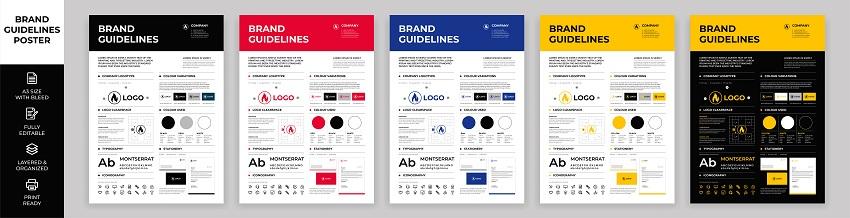

Even though branding applies to all of our interactions, in writing it mostly serves to introduce who and what you are. It's the opening line before you get to the substance of the conversation. It sets a tone. It declares your aspirations and projects the reputation you want to have. And it can hurt your proposals and damage your win rate.
If your branding is minimal and consists primarily of your logo, color scheme, and a uniform appearance, that's (probably) not going to hurt anything. A little visual consistency can be a good thing.
But if you consider your branding to be projecting an image through slogans and mission/value/whatever statements, the problem is that branding can't just be sprinkled on the top of a proposal. A proposal is the closing of the sale and not the start. A proposal is the proof that you can deliver as promised so that the customer will sign the contract. A proposal is about what the customer will get and needs to be substantive and compelling. A proposal comes after you've made an impression. A proposal is the substance that is needed after an introduction.
Be honest. Does your branding deliver substance? Is your chosen branding even capable of that in a proposal?
If your slogan is an unsubstantiated claim, like most are, it does more harm than good to feature it in a proposal. And since most slogans are so watered down and lacking in substance they can never be contradicted, they also can't be substantiated. Self-aggrandizing and unprovable is not the impression you want the customer to have of you in the proposal stage.
A slogan says something about your company when it's on a business card. But in a proposal, it stands out as a statement that intentionally says nothing substantive that could help the customer make their decision. This is the opposite of what the customer is looking for from your proposal. Aspirational pleasantries might be enough to get a conversation started, but they get in the way when you're at the stage where you're trying to get the customer to sign a contract. This is what's at the core of the complicated relationship between branding and proposals.
Does your branding support your proposals?
Branding can also be far deeper that logos, graphic design, slogans, and pleasantries. It's what you want the customer to conclude about your relationship with them. In some ways it is the relationship because regardless of what you think you're projecting, your brand is what the customer is really thinking about you.
This is where there is some overlap between the goals of branding and the goals of proposal writing. Proposal writing seeks to help the customer reach the conclusion that they should accept your proposal. Branding seeks to help the customer identify your company in a favorable way. Branding that clarifies what you are like to work with makes sense for proposals. If it is proven in your proposal. The challenge is that different customers have different expectations regarding the working relationships they want with their vendors, and proposals that want to win will adapt to the customer's preferences.
Proposals should be constructed around proof points and differentiators. But they are at their most effective when they are built from the ground up around the customer's perspective instead of your own. When your proposal is completely written to reflect the customer's goals and preferences, it's hard to also make it prove your own aspirational slogan. And doing so may work against the messaging of the proposal and potentially hurt your win probability. This is what tends to drive branding to a watered-down message that applies to everyone.
Insert better branding here
If you want to include your branding in your proposals, you should give some thought to how you win business when creating your branding. Instead of lofty, fluffy, happily unprovable branding that could never offend anyone while sounding pleasing and beneficial, consider branding that is provable. Consider branding that will be in obvious contradiction if you don't live up to the claims. Consider branding that requires everyone in your company to live the proof. Consider branding that when you put it in the header on every page in your proposals, the customer will also see it proven on every page. Or don't even bother.
Proposals are the proof that you will deliver as promised. In a proposal, branding should be part of the promise. Branding should be dangerous. If your people can't live up to the promise, you'll create dissatisfied customers. The remedy isn't watered down branding. It's stepping up and delivering as promised. Every proposal is a chance to ruin your past performance record. It's also a chance to achieve a past performance record you can be proud of. Always fulfill your promises. But if you want to win, your promises must require you to stretch beyond what your competitors can deliver.
Remember, you are branding even when you are not trying. If don't promise anything that requires you to stretch, that is your branding. If you promise more than you can deliver, that is also your branding. No matter what it says in your slogan, you are what the customer thinks about your ability to deliver.
If you stop intentionally branding and start writing great proposals, you may find that you are doing better branding than if you start your proposals with a focus on branding. If all of your business comes from the proposals you win, you might want to put some thought into making sure any branding that you do is part of how you accomplish winning. And delivering.
Let's discuss it!
You can post now and register later. If you have an account, sign in now to post with your account.
Note: Your post will require moderator approval before it will be visible.